Why the Brand on Your Mushroom Supplement Matters More Than the Species
Walk into any health food store and you will find dozens of mushroom supplements featuring the same species — lion’s mane, reishi, cordyceps, chaga, turkey tail. The labels look similar. The promises overlap. But the quality behind those labels varies enormously, and the brand you choose may matter more than which mushroom you pick.
In This Article
- Why the Brand on Your Mushroom Supplement Matters More Than the Species
- What Makes a Mushroom Supplement Brand Trustworthy?
- Top Mushroom Supplement Brands Ranked
- 1. Real Mushrooms — Our Top Recommendation
- 2. Om Mushrooms
- 3. Host Defense
- 4. Four Sigmatic
- 5. Onnit (Shroom Tech)
- Red Flags — Brands to Avoid
- How to Read a Mushroom Supplement Label
- Fruiting Body vs. Mycelium vs. Biomass
- Beta-Glucan Percentage
- The “Other Ingredients” Section
- Extract Ratio vs. Raw Powder
- Bottom Line — Which Brand Should You Start With?
- References
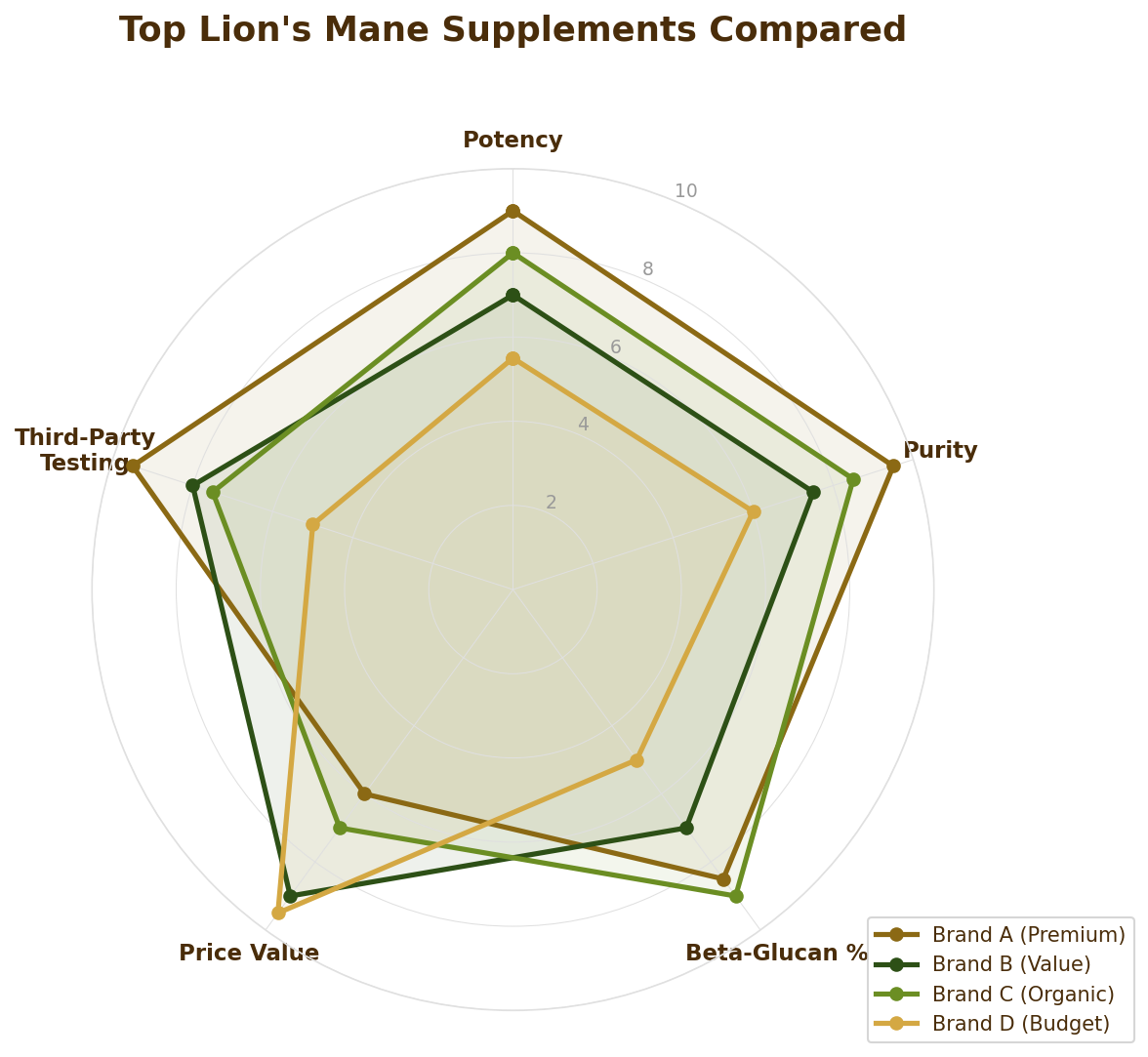
Here is why: two lion’s mane supplements can list the exact same species on the front label while delivering wildly different concentrations of bioactive compounds. One may contain 100% fruiting body extract with verified beta-glucan content above 25%. The other may be mostly grain starch from a mycelium-on-rice growing process, with no third-party testing and no disclosure of what is actually in the capsule. Same species, completely different products.
If you are exploring mushroom supplements for the first time, the brand decision is where your money either works for you or gets wasted. This guide ranks the best mushroom supplement brands based on transparency, testing, ingredient quality, and value — so you can spend confidently on a product that actually delivers what the label promises.
What Makes a Mushroom Supplement Brand Trustworthy?
Before we rank specific brands, you need to understand the quality markers that separate serious supplement companies from those coasting on marketing.
Third-party testing: Any reputable brand sends products to an independent laboratory to verify identity, potency, and purity — including screening for heavy metals, pesticides, and microbial contamination. In-house testing is not sufficient.
Certificate of Analysis (COA) availability: A COA is the document third-party labs issue after testing. The best brands make COAs available per batch, meaning each production run has its own report. If a brand cannot provide a COA on request, that tells you something about their confidence in what is inside their product.
Beta-glucan disclosure: Beta-glucans are polysaccharides found in mushroom cell walls that research suggests may support immune function. A stated beta-glucan percentage on the label tells you the product has been tested for potency, not just identity.
Sourcing transparency: Where the mushrooms are grown, whether the product uses fruiting body or mycelium, and how they are harvested all affect what you are consuming. Our fruiting body vs. mycelium comparison covers why this distinction matters so much.
Extraction method: Mushroom cell walls are made of chitin, which is difficult for the human body to break down. Proper extraction — hot water, alcohol, or dual-extraction — concentrates bioactive compounds and makes them more bioavailable. Our guide to lion’s mane extract types breaks down how extraction methods affect potency.
Top Mushroom Supplement Brands Ranked
Get Our Free Mushroom Supplement Guide
Lab-tested brands, dosage protocols, and quality markers — delivered free.
No spam. Unsubscribe anytime.
We evaluated these brands across the criteria above, weighting transparency and verified quality metrics most heavily. Here is where the best mushroom supplement brands stand.
1. Real Mushrooms — Our Top Recommendation
Real Mushrooms has built a reputation on a straightforward and verifiable promise: 100% fruiting body extract, beta-glucan content verified above 25% through third-party testing, batch-specific Certificates of Analysis, and manufacturing in a cGMP-certified facility. In a market crowded with vague labels, that combination of measurable claims and available documentation stands apart.
The company was founded by Skye Chilton, son of Jeff Chilton — a mycologist who has worked in the mushroom industry since the 1970s. Their product line spans single-species extracts and multi-mushroom blends, with every product using exclusively fruiting body material and no grain fillers.
For first-time buyers who want the highest confidence that what is on the label matches what is in the capsule, Real Mushrooms is the brand we recommend starting with. Explore their full product line at the Real Mushrooms website. For a detailed look at their lion’s mane product specifically, read our full Real Mushrooms review.
2. Om Mushrooms
Om Mushrooms carries USDA Organic certification, uses fruiting body material, and offers transparent labeling. The brand has one of the widest product ranges in the category — single-species capsules, powder blends, drink mixes, and broths — making them accessible to people who prefer different formats.
Where Om sits slightly behind Real Mushrooms in our ranking is on the depth of publicly accessible per-batch lab documentation. That said, Om is an excellent choice for buyers who value organic certification and product variety. Browse their lineup at the Om Mushrooms website.
3. Host Defense
Host Defense is the most recognized name in the mushroom supplement space, founded by Paul Stamets — arguably the world’s most famous living mycologist. His TED talks, books, and advocacy have brought functional mushrooms into mainstream awareness.
The brand uses a blend of fruiting body and mycelium in their formulations. Stamets has publicly defended the inclusion of mycelium, arguing that compounds like erinacines offer benefits that fruiting body alone does not provide. This is a legitimate scientific position, though the mushroom supplement community remains divided on whether blended products deliver sufficient concentrations of either compound type.
The notable limitation is transparency around beta-glucan content. Host Defense does not publicly disclose beta-glucan percentages on their labels. For quality-focused buyers who use beta-glucan content as an evaluation metric, this is a meaningful gap. Despite this, Host Defense maintains a reputation for consistent quality and wide retail availability. For buyers who trust the Stamets name, Host Defense is a solid choice — but those who want verified beta-glucan data should look to brands like Real Mushrooms.
4. Four Sigmatic
Four Sigmatic occupies a different corner of the market: the crossover between functional mushrooms and everyday beverages. Their mushroom coffee blends, elixirs, and protein powders have brought functional mushrooms to people who would never buy a bottle of capsules. For more on what mushroom coffee can realistically deliver, see our mushroom coffee benefits guide.
This mainstream accessibility is genuinely valuable. The best supplement is the one you actually take every day, and if swapping your regular coffee for a mushroom coffee blend means consistent daily exposure with zero friction, that is a meaningful advantage over a capsule bottle that sits forgotten in a cabinet.
The trade-off is dose. A serving of Four Sigmatic mushroom coffee may deliver 250mg to 500mg of total mushroom extract — the lower end of researched ranges. For targeted support at researched dosing levels, dedicated supplements are more effective. But for habit-building and daily baseline exposure, Four Sigmatic is hard to beat. Check out their product range at the Four Sigmatic website.
5. Onnit (Shroom Tech)
Onnit approaches mushroom supplementation from the performance and fitness angle. Their Shroom Tech line is built primarily around cordyceps, which research suggests may support energy production, oxygen utilization, and athletic endurance. This makes Onnit a natural fit for athletes and anyone whose primary interest in mushrooms is physical performance rather than cognitive support.
For those building a broader functional mushroom stack that includes a cordyceps component, Onnit is worth considering alongside a dedicated cognitive mushroom like lion’s mane. Explore their offerings at the Onnit website.
Red Flags — Brands to Avoid
Not every mushroom supplement on the market deserves your money. Here are the warning signs that should steer you away from a product, regardless of how professional the branding looks.
- Proprietary blends: If a label lists a “mushroom blend” with a total weight but does not disclose how much of each species is included, you have no way to evaluate the dose. This is a deliberate choice to hide information.
- No beta-glucan testing or disclosure: A brand that has not tested for beta-glucan content — or tested but will not share results — is asking you to take their quality claims on faith.
- Mycelium biomass on grain: Products listing “mycelium biomass” as the primary ingredient may contain significant residual grain starch, diluting active mushroom compounds. Look for “fruiting body extract” or at minimum “mycelium extract” — the word “extract” indicates active compounds have been concentrated and separated from the growing substrate.
- No Certificate of Analysis available: If a brand cannot provide a current COA from an independent lab, you cannot verify any of their label claims.
How to Read a Mushroom Supplement Label
Knowing which brands to trust is important, but developing the ability to evaluate any label yourself is even more valuable.
Fruiting Body vs. Mycelium vs. Biomass
The supplement facts panel should clearly state which part of the mushroom is used. “Fruiting body” means the actual mushroom structure. “Mycelium” is the root-like network. “Mycelium biomass” often means mycelium was grown on grain and ground up together with the substrate — part mushroom, part grain starch. The distinction between “mycelium extract” (concentrated active compounds) and “mycelium biomass” (ground-up growing substrate) is critical.
Beta-Glucan Percentage
Look for a stated beta-glucan percentage, ideally above 20% and verified by third-party testing. This number tells you the concentration of one of the most well-researched bioactive compound groups in mushrooms. A product with no disclosed percentage makes comparison impossible.
The “Other Ingredients” Section
Read the “other ingredients” section carefully. This is where fillers, flow agents, and binders appear. Some are standard and harmless (cellulose capsules, silica). Others — grain starch, maltodextrin, or long lists of additives — may indicate a less concentrated product.
Extract Ratio vs. Raw Powder
Some labels state an extract ratio like 8:1 or 10:1, meaning the product is concentrated from a larger quantity of raw material. Raw mushroom powder without extraction has not been through this concentration process, and chitin in the cell walls may limit bioavailability. Extract ratios are useful for comparison, though beta-glucan percentage is a more direct measure of potency.
Bottom Line — Which Brand Should You Start With?
If you are buying your first mushroom supplement, our recommendation is clear: start with Real Mushrooms. Their combination of 100% fruiting body formulation, verified beta-glucan content above 25%, per-batch Certificates of Analysis, and cGMP manufacturing sets the standard for what a trustworthy mushroom supplement brand looks like.
If organic certification is a priority, Om Mushrooms is an excellent alternative with USDA Organic status. If you want to integrate mushrooms into your daily routine with minimal effort, Four Sigmatic’s mushroom coffee makes compliance effortless. And if athletic performance is your primary goal, Onnit’s Shroom Tech is purpose-built for that use case.
Whichever brand you choose, apply the quality markers from this guide: look for fruiting body or proper mycelium extract, check for stated beta-glucan content, ask for a COA, and avoid proprietary blends. A few minutes evaluating your options will make the difference between a product that may genuinely support your health goals and one that is mostly grain starch in a capsule.
For a deeper comparison of specific lion’s mane products from these brands, see our best lion’s mane supplement ranking. Individual results vary with any supplement, and you should consult your healthcare provider before adding mushroom supplements to your routine.
References
- Spelman K, et al. “Neurological Activity of Lion’s Mane (Hericium erinaceus).” Journal of Restorative Medicine, 2017.
- Hobbs C. “Medicinal Mushrooms: Ancient Remedies Rediscovered — Quality Analysis of Commercial Products.” HerbalGram, 2003.
- ConsumerLab.com — Independent Supplement Testing and Reviews
- Lion’s Mane — Examine.com Evidence-Based Research Summary