Chaga has earned the nickname “King of Mushrooms” — and while marketing hype is common in the supplement world, chaga’s reputation rests on a genuinely unusual biochemical profile. Found growing as a dark, charcoal-like mass on birch trees across Siberia, Northern Canada, and Scandinavia, chaga (Inonotus obliquus) has been used in Russian and Northern European folk medicine for centuries, typically brewed as a tea for general vitality. What makes chaga distinctive is its extraordinary antioxidant concentration and its unique relationship with birch bark chemistry — producing compounds found in no other mushroom.
In This Article
- What Is Chaga?
- Key Active Compounds in Chaga
- Research-Backed Benefits of Chaga Mushroom
- Exceptional Antioxidant Activity
- Immune System Modulation
- Anti-Inflammatory Properties
- Gut Health Support
- Skin Health
- How Chaga Differs From Other Functional Mushrooms
- How to Use Chaga
- Common Forms
- Typical Dosage
- What to Look for in a Chaga Supplement
- Wild-Harvested vs. Cultivated
- Extraction Method
- Third-Party Testing
- Side Effects and Precautions
- The Bottom Line on Chaga Mushroom Benefits
- Chaga Mushroom FAQ
- Is it safe to take chaga every day?
- What is the best way to take chaga?
- How does chaga compare to other medicinal mushrooms?
- References
If you are already familiar with lion’s mane for cognitive support or reishi for immune modulation and sleep, chaga occupies yet another corner of the functional mushroom landscape. Its strengths center on antioxidant defense, immune support, and skin health — making it a compelling addition to a broader wellness protocol rather than a direct substitute for cognitive-focused mushrooms.
What Is Chaga?
Despite being called a mushroom, chaga is technically a sclerotium — a hardened mass of fungal mycelium that forms on the exterior of living birch trees. It is not a fruiting body in the traditional sense. The dark, irregularly shaped growth can take 15 to 20 years to mature and is almost always wild-harvested rather than commercially cultivated. Chaga’s most valued compounds depend on its symbiotic relationship with living birch trees — a relationship that is difficult to replicate in a laboratory.
Chaga has the deepest roots in Siberian and Russian folk medicine, where it was traditionally shaved from birch trunks, dried, and simmered into a dark tea for general wellness. In Finland, chaga tea (known as tikkatee) has a similar history of traditional use, though these practices predate modern scientific investigation.
A sustainability note: because chaga must be wild-harvested from mature birch trees and takes many years to regrow, overharvesting is a legitimate concern. Demand has increased significantly, and some ecologists have raised alarms about wild chaga populations in heavily harvested regions. When purchasing chaga products, look for brands that address sourcing sustainability.
Key Active Compounds in Chaga
Chaga’s biological activity comes from a distinctive set of compounds, several of which are uncommon or unique among functional mushrooms.
Melanin. The dark exterior of chaga is extremely rich in melanin, the same class of pigments found in human skin. Research suggests melanin may contribute to chaga’s antioxidant activity and its traditional association with skin health, though human studies on this mechanism remain limited.
Betulinic acid and betulin. These triterpenoid compounds originate from the birch bark that chaga colonizes — not from the fungus itself. As chaga grows, it absorbs and concentrates betulin from the birch tree and converts a portion into betulinic acid. This is why birch-grown chaga is considered essential: chaga cultivated on other substrates will not contain meaningful levels of these compounds.
Triterpenoids. Beyond betulinic acid, chaga contains inotodiol and other triterpenoids that have shown antioxidant and anti-inflammatory properties in laboratory studies.
Polysaccharides and beta-glucans. Like other functional mushrooms, chaga contains polysaccharides that may support immune function. Its beta-glucan profile interacts with immune cell receptors in the gut and throughout the body.
Superoxide dismutase (SOD). Chaga is notably high in superoxide dismutase, an antioxidant enzyme the body also produces naturally. SOD neutralizes superoxide radicals, one of the most common reactive oxygen species. While dietary SOD bioavailability is debated, chaga’s SOD content is frequently cited as a distinguishing feature.
Research-Backed Benefits of Chaga Mushroom
Get Our Free Mushroom Supplement Guide
Lab-tested brands, dosage protocols, and quality markers — delivered free.
No spam. Unsubscribe anytime.
Most existing chaga research is preclinical — conducted in vitro or in animal models — with limited human clinical trial data. We will be transparent about these limitations throughout.
Exceptional Antioxidant Activity
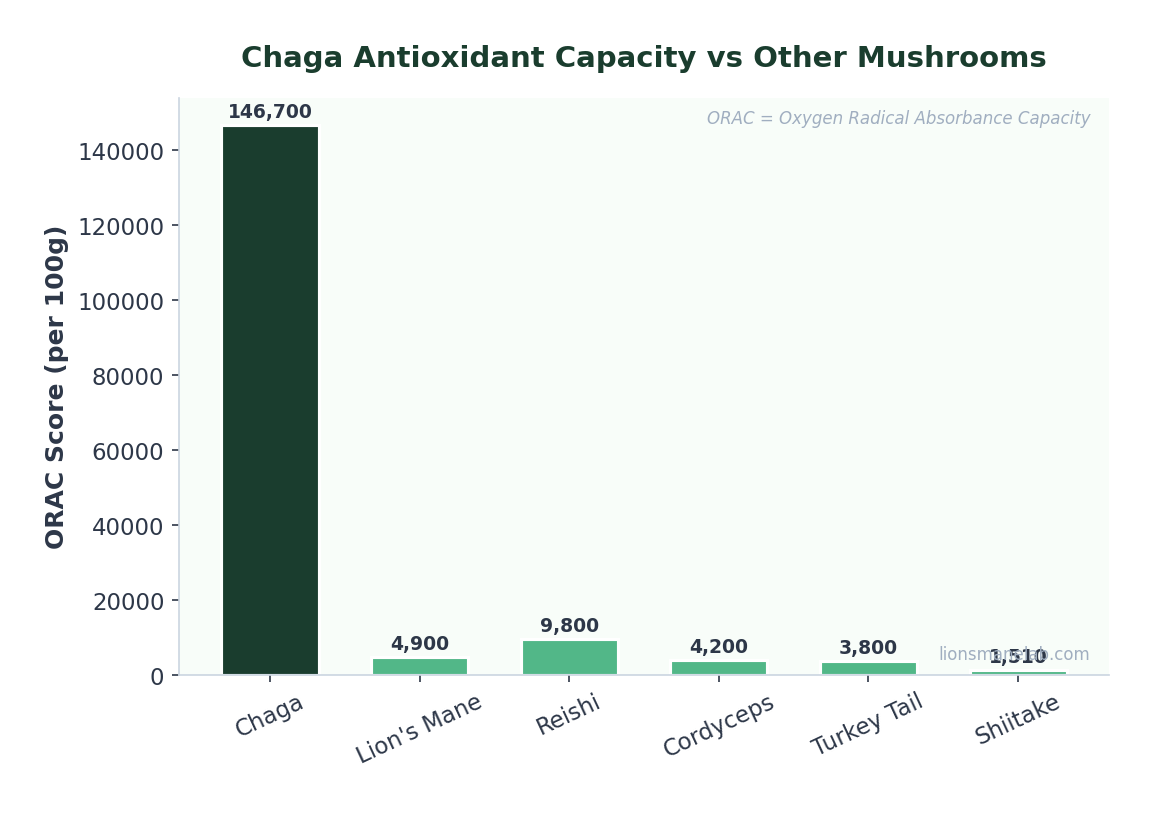
Chaga has recorded some of the highest ORAC (Oxygen Radical Absorbance Capacity) scores of any food or supplement tested. The combination of melanin, SOD, polyphenols, and triterpenoids creates a broad-spectrum antioxidant profile that is genuinely unusual in the natural world.
A necessary caveat: the ORAC methodology has limitations. The USDA withdrew its ORAC database in 2012, noting that lab-measured values do not necessarily translate to antioxidant effects in the body. Bioavailability and metabolic processing affect how much activity reaches your cells. That said, the concentration of diverse antioxidant compounds in chaga is notable even when interpreting ORAC data conservatively.
Immune System Modulation
Like turkey tail mushroom, chaga does not simply “boost” the immune system — a misleading oversimplification. Research suggests chaga’s polysaccharides and beta-glucans may support balanced immune function by influencing natural killer cell activity, macrophage function, and cytokine signaling. Most of this evidence comes from animal and in vitro studies, so caution is warranted when extrapolating to human outcomes.
Anti-Inflammatory Properties
Research suggests chaga extracts may help modulate NF-kB signaling and reduce pro-inflammatory cytokine production in laboratory settings. Chronic low-grade inflammation is associated with numerous age-related health concerns, making anti-inflammatory support a relevant area of interest — though human clinical trials are needed to confirm these effects at typical supplementation doses.
Gut Health Support
Chaga’s polysaccharides may function as prebiotics, supporting beneficial gut bacteria. Some animal studies suggest chaga extract may help maintain gut barrier function and modulate microbiome composition. Given the growing understanding of the gut-immune axis, this prebiotic potential may represent another pathway through which chaga supports immune health.
Skin Health
Chaga’s melanin content and antioxidant profile have generated interest in skin health applications. Oxidative stress is a primary driver of skin aging, and some researchers have explored whether chaga’s compounds may help protect skin cells from UV-induced damage. This remains primarily a theoretical benefit, supported by chaga’s chemistry rather than human clinical data on skin outcomes.
How Chaga Differs From Other Functional Mushrooms
If you are building a functional mushroom stack, understanding what makes chaga distinct helps you decide whether it belongs in your protocol.
Antioxidant profile. Chaga’s antioxidant concentration exceeds that of reishi, turkey tail, lion’s mane, and cordyceps by a wide margin. No other commonly used functional mushroom approaches its combination of melanin, SOD, and polyphenolic compounds.
Melanin content. Chaga is the only functional mushroom widely used for its melanin concentration, giving it a unique connection to skin health research that other mushrooms do not share.
Birch-derived compounds. Betulinic acid and betulin are exclusive to birch-grown chaga — not found in lion’s mane, reishi, turkey tail, or cordyceps. This gives chaga a biochemical profile that is not redundant with other mushrooms in a stack.
What chaga does not do. Chaga lacks hericenones and erinacines (lion’s mane’s NGF-stimulating compounds), ganoderic acids (reishi’s sleep-supporting triterpenes), PSK and PSP (turkey tail’s immune polysaccharides), and cordycepin (cordyceps’ energy compound). Chaga is complementary to these mushrooms, not a replacement for any of them.
How to Use Chaga
Common Forms
- Tea (traditional): Dried chaga chunks simmered in hot water for 30 to 60 minutes produce a dark, earthy brew with a mild vanilla-like undertone. Tea primarily extracts water-soluble compounds but may miss alcohol-soluble triterpenoids.
- Powder: Ground chaga can be mixed into coffee, smoothies, or other beverages. Four Sigmatic [AFFILIATE LINK PLACEHOLDER: FOUR SIGMATIC] offers chaga blended with coffee for a convenient daily format, though the chaga dose per serving in blended products is typically lower than standalone supplements.
- Capsules: Standardized extracts in capsule form offer the most consistent dosing. Real Mushrooms [AFFILIATE LINK PLACEHOLDER: REAL MUSHROOMS] provides chaga capsules with verified beta-glucan content and proper extraction methods.
- Dual-extract tinctures: Liquid extracts using both hot water and alcohol capture the broadest spectrum of chaga’s active compounds. This format is most likely to deliver the full range of bioactives.
Typical Dosage
Most chaga supplements use doses of 1,000mg to 3,000mg per day of a concentrated extract. If you are new to chaga, starting at 500mg to 1,000mg for the first week or two allows you to assess tolerance. Chaga does not have strong stimulating or sedating properties, so timing is flexible — morning or afternoon dosing is common.
What to Look for in a Chaga Supplement
Wild-Harvested vs. Cultivated
This distinction matters more for chaga than for nearly any other functional mushroom. Wild-harvested chaga from birch trees contains betulinic acid, betulin, and the full melanin profile that define chaga’s unique benefits. Cultivated chaga — grown on grain or in fermentation tanks — typically lacks these birch-derived compounds. If a product does not specify wild-harvested birch-grown sourcing, that is a red flag.
Extraction Method
Dual extraction (hot water plus alcohol) is the gold standard. Hot water pulls out beta-glucans and polysaccharides; alcohol captures triterpenoids including betulinic acid. Products using only one method deliver an incomplete compound profile. Real Mushrooms [AFFILIATE LINK PLACEHOLDER: REAL MUSHROOMS] uses proper extraction and publishes beta-glucan content on their labels.
Third-Party Testing
Look for products with Certificates of Analysis (COAs) from independent laboratories, verifying beta-glucan content, absence of heavy metals and pesticides, and confirming the product matches its label claims.
Side Effects and Precautions
Chaga has a favorable safety profile at standard doses, but carries specific precautions that set it apart from other functional mushrooms.
- Oxalate content: Chaga is high in oxalates, which can contribute to kidney stone formation in susceptible individuals. People with a history of kidney stones, kidney disease, or oxalate sensitivity should consult their healthcare provider before using chaga. This is chaga’s most distinctive safety concern.
- Blood thinner interactions: Research suggests chaga may have mild antiplatelet properties. If you take warfarin, heparin, aspirin, or other blood thinners, consult your doctor before supplementing.
- Diabetes medication interactions: Some animal studies suggest chaga may influence blood sugar levels. If you take insulin or oral diabetes medications, consult your healthcare provider, as chaga could theoretically alter medication effects.
- Surgery: Discontinue chaga at least two weeks before any scheduled procedure due to potential effects on blood clotting and blood sugar.
- Pregnant or nursing women: Insufficient safety data exists. The conservative approach is to avoid chaga during pregnancy and breastfeeding.
- Autoimmune conditions: Because chaga may modulate immune activity, individuals with autoimmune conditions should consult their specialist before use.
For individuals outside these categories, chaga is generally well tolerated at standard doses. Consult your healthcare provider before starting any new supplement.
The Bottom Line on Chaga Mushroom Benefits
Chaga occupies a unique position in the functional mushroom world. Its antioxidant concentration is unmatched, its melanin and betulinic acid content set it apart biochemically, and centuries of traditional use provide a long history of human consumption. The primary limitation is the research base — preclinical evidence is promising, but large-scale human clinical trials remain limited.
For those already using lion’s mane for cognitive support and reishi or turkey tail for immune modulation, chaga fills the antioxidant role in a way other mushrooms cannot. If you are building a functional mushroom stack, chaga is a logical addition for its non-redundant compound profile. Choose wild-harvested, birch-grown, dual-extracted products with transparent testing. Start at a moderate dose. And if you have kidney concerns, take blood thinners, or use diabetes medications, consult your healthcare provider before starting.
Chaga Mushroom FAQ
Is it safe to take chaga every day?
Chaga has a long history of traditional daily use, particularly in Siberian and Northern European folk medicine. Short-term studies have not reported significant adverse effects at standard doses. However, chaga contains high levels of oxalates, which may be a concern for individuals prone to kidney stones. Consult your healthcare provider before long-term daily use.
What is the best way to take chaga?
Chaga is most commonly consumed as a hot water extraction (tea), tincture, or powdered extract in capsules. Hot water extraction is considered the most effective method for releasing water-soluble compounds like beta-glucans. Dual-extraction products (water and alcohol) may capture a broader range of bioactive compounds including triterpenes.
How does chaga compare to other medicinal mushrooms?
Chaga stands out for its exceptionally high antioxidant content — it has one of the highest ORAC values of any natural food. While lion’s mane is primarily studied for cognitive benefits and reishi for stress and sleep, chaga research focuses on immune modulation and antioxidant activity. Many practitioners recommend combining multiple mushroom species for complementary benefits.