Cordyceps Mushroom: The Energy Mushroom With Centuries of Traditional Use
Cordyceps is one of the most distinctive organisms in the functional mushroom world. It belongs to a genus of parasitic fungi that naturally infects insects in the wild, but the species used in supplements — Cordyceps militaris — is safely cultivated on organic substrates, producing the same bioactive compounds as its wild counterpart, Cordyceps sinensis, without the extreme rarity and cost. Traditional Tibetan and Chinese medicine practitioners have used cordyceps for centuries to support vitality, endurance, and respiratory function.
In This Article
- Cordyceps Mushroom: The Energy Mushroom With Centuries of Traditional Use
- What Are Cordyceps Mushrooms?
- Key Active Compounds in Cordyceps
- Research-Backed Cordyceps Mushroom Benefits
- Energy Production and Anti-Fatigue Effects
- Oxygen Utilization and VO2 Max
- Immune System Modulation
- Blood Sugar Regulation
- Anti-Aging and Antioxidant Properties
- Cordyceps vs. Other Functional Mushrooms
- How to Take Cordyceps
- Dosage
- Timing
- Stacking With Other Mushrooms
- What to Look For in a Cordyceps Supplement
- Fruiting Body Source
- Cordycepin and Beta-Glucan Content
- Third-Party Testing
- Who Should Consider Cordyceps?
- Side Effects and Safety
- The Bottom Line on Cordyceps Mushroom Benefits
- References
If you are already familiar with lion’s mane mushroom and its cognitive benefits, cordyceps occupies a complementary niche. Where lion’s mane targets the nervous system through Nerve Growth Factor stimulation, cordyceps is most commonly associated with cellular energy production, oxygen utilization, and physical endurance.
What Are Cordyceps Mushrooms?
The genus Cordyceps includes over 400 species, but two dominate the supplement conversation.
Cordyceps sinensis is the wild species that grows on caterpillar larvae at high altitudes in the Tibetan Plateau and Himalayan regions. Known as “yartsa gunbu” in Tibetan (literally “winter worm, summer grass”), it has been used in traditional medicine for centuries. However, wild C. sinensis is extraordinarily rare — prices can exceed $20,000 per kilogram — and cannot be sustainably harvested at supplement scale.
Cordyceps militaris is the species you will actually find in quality supplements. It can be reliably cultivated in controlled environments and produces many of the same bioactive compounds as its wild relative, including cordycepin, the signature compound driving most of the scientific interest. When we refer to cordyceps mushroom benefits throughout this article, we mean C. militaris unless otherwise stated.
Key Active Compounds in Cordyceps
Get Our Free Mushroom Supplement Guide
Lab-tested brands, dosage protocols, and quality markers — delivered free.
No spam. Unsubscribe anytime.
Cordycepin (3′-deoxyadenosine) is the signature compound and the one generating the most research interest. Structurally similar to adenosine — a molecule central to energy transfer and cellular signaling — cordycepin has been studied for its potential roles in supporting healthy inflammatory responses, energy metabolism, and immune function. It is the primary compound that distinguishes cordyceps from other functional mushrooms.
Adenosine is present in cordyceps and plays a well-established role in energy metabolism. As a building block of ATP (adenosine triphosphate), the molecule your cells use as their primary energy currency, adenosine content may contribute to cordyceps’ traditional reputation as an energy-supporting mushroom.
Beta-glucans and polysaccharides interact with immune receptors and may help modulate immune system activity. While not unique to cordyceps — they are also prominent in reishi and turkey tail — their presence adds to the overall functional value of a quality extract.
Research-Backed Cordyceps Mushroom Benefits
The following benefits have varying levels of scientific support. Some rest on human studies, while others are primarily supported by preclinical research.
Energy Production and Anti-Fatigue Effects
Research suggests that cordyceps may enhance ATP production by supporting mitochondrial function at the cellular level. Some human studies have shown that supplementation may reduce perceived fatigue and support sustained energy output during prolonged physical or mental effort. These effects appear to build gradually with consistent daily use rather than producing an immediate stimulant-like response.
Oxygen Utilization and VO2 Max
Several studies have examined cordyceps’ potential to support oxygen utilization during exercise. Some research suggests supplementation may support VO2 max — the maximum rate of oxygen consumption during exercise — particularly in older or less-trained individuals. However, this research is still preliminary. Studies in elite athletes have produced more mixed results, suggesting cordyceps may offer the most noticeable benefit to those not already at peak cardiovascular fitness.
Immune System Modulation
Like other functional mushrooms, cordyceps contains beta-glucans that interact with the immune system. Research suggests these compounds may help modulate immune cell activity, including natural killer cells and macrophages. Some studies indicate that cordyceps may support a balanced immune response rather than simply stimulating immune activity — an important distinction. Individual results vary, and anyone with an immune-related condition should consult their healthcare provider.
Blood Sugar Regulation
Preclinical research has explored cordyceps’ potential role in supporting healthy blood sugar levels. Some animal studies suggest that cordyceps polysaccharides may help support insulin sensitivity and glucose metabolism. Human clinical data in this area remains limited, and cordyceps should not be considered a substitute for any protocol prescribed by a healthcare provider.
Anti-Aging and Antioxidant Properties
Cordyceps demonstrates antioxidant activity in laboratory studies, with cordycepin and polysaccharide fractions showing free-radical scavenging properties in vitro. Some animal studies suggest supplementation may support markers associated with cellular aging, though translating these preclinical findings to human outcomes requires caution.
Cordyceps vs. Other Functional Mushrooms
Each functional mushroom has a distinct profile. Understanding where cordyceps fits helps you decide whether it belongs in your routine.
- Cordyceps vs. Lion’s Mane: Cordyceps targets cellular energy and endurance; lion’s mane targets the nervous system through NGF stimulation. These are complementary, not competing. Many users take both. For a detailed comparison, see our mushroom brain health comparison.
- Cordyceps vs. Reishi: Cordyceps is an energy mushroom best taken in the morning; reishi is a calming mushroom best taken in the evening. Together, they create a 24-hour protocol.
- Cordyceps vs. Turkey Tail: Both support immune function through beta-glucans, but turkey tail’s immune research base is significantly deeper. Cordyceps brings the unique energy angle that turkey tail does not.
The most effective approach for many people is building a stack that addresses multiple systems. Our functional mushroom stack guide walks through how to combine cordyceps with lion’s mane, reishi, and other compounds in tiered protocols.
How to Take Cordyceps
Dosage
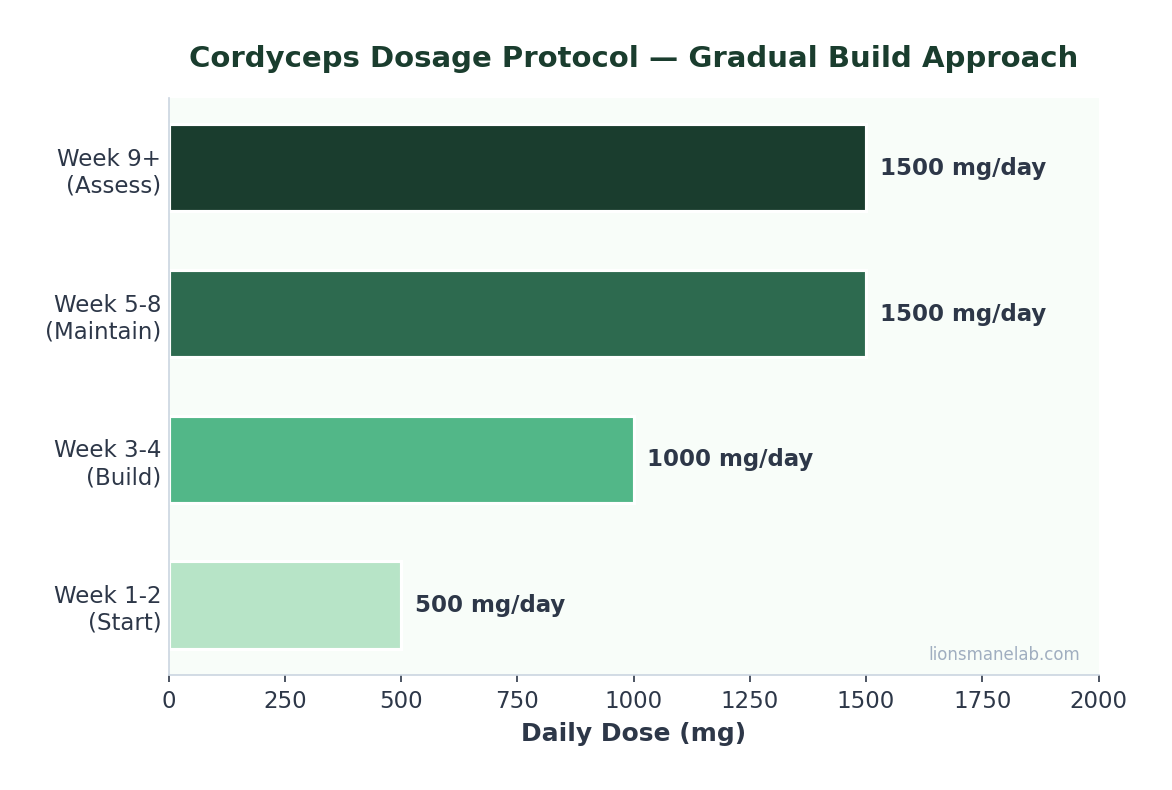
Most research and product formulations point to 1,000mg to 3,000mg per day of a quality Cordyceps militaris extract:
- Starting dose: 500mg to 1,000mg per day for the first one to two weeks
- Maintenance dose: 1,000mg to 1,500mg per day for general energy and wellness support
- Higher dose: 2,000mg to 3,000mg per day, sometimes used in research contexts and by athletes
Individual results vary. Consulting your healthcare provider before beginning any new supplement is always recommended.
Timing
Because cordyceps is associated with energy support, morning dosing is generally preferred. Many users take it with breakfast or before a workout. It is not a stimulant like caffeine, but morning timing aligns best with its energy-supporting profile.
Stacking With Other Mushrooms
Cordyceps pairs particularly well with lion’s mane. A common morning protocol is 1,000mg lion’s mane plus 1,000mg cordyceps, taken together with food — lion’s mane for cognitive clarity, cordyceps for sustained energy. Adding reishi in the evening rounds out the stack with immune and sleep support. For specific protocols, our functional mushroom stack guide covers beginner through advanced tiers.
What to Look For in a Cordyceps Supplement
Fruiting Body Source
Look for products made from Cordyceps militaris fruiting body, not mycelium grown on grain. Fruiting body extracts contain higher concentrations of cordycepin and beta-glucans, while mycelium-on-grain products often contain significant starch filler. If a label says “Cordyceps sinensis” at a consumer price, it is almost certainly mislabeled — genuine wild C. sinensis is too rare for standard supplements.
Cordycepin and Beta-Glucan Content
Premium extracts will disclose cordycepin concentration — the compound most unique to cordyceps. For beta-glucans, look for content above 25%. Brands like Real Mushrooms [AFFILIATE LINK PLACEHOLDER: REAL MUSHROOMS] verify and disclose beta-glucan percentages on their cordyceps products.
Third-Party Testing
A Certificate of Analysis (COA) from an independent lab should be available, verifying potency and absence of contaminants. Om Mushrooms [AFFILIATE LINK PLACEHOLDER: OM MUSHROOMS] is another brand offering cordyceps products with transparent testing and organic certification.
Who Should Consider Cordyceps?
- Athletes and active individuals: The research on oxygen utilization, ATP production, and anti-fatigue effects makes cordyceps a natural fit for anyone focused on physical performance.
- People experiencing general fatigue: If you deal with persistent low energy not explained by a diagnosed condition, cordyceps’ support for mitochondrial function may be worth exploring alongside foundational lifestyle factors.
- Knowledge workers and biohackers: Mental endurance requires cellular energy just as physical endurance does. Some users report cordyceps supports sustained focus during long work sessions.
- Immune support seekers: While turkey tail and reishi have deeper immune research bases, cordyceps’ beta-glucan content still contributes meaningful immune-modulating activity, particularly when stacked with other mushrooms.
Side Effects and Safety
Cordyceps has a generally favorable safety profile based on available research and centuries of traditional use. Most healthy adults tolerate it well at standard doses. However, certain populations should exercise caution.
- People on immunosuppressant medications: Cordyceps may modulate immune activity and could theoretically interfere with immunosuppressive therapy. Consult your doctor.
- People on blood-thinning medications: Some research suggests cordyceps may have mild antiplatelet properties. If you take warfarin, heparin, or other blood thinners, speak with your healthcare provider.
- People with autoimmune conditions: The immune-modulating properties of cordyceps could theoretically complicate conditions where the immune system is already dysregulated.
- Pregnant or nursing women: Insufficient safety data exists. The conservative approach is to avoid cordyceps until more research is available.
The most commonly reported side effects are mild — digestive discomfort, nausea, or dry mouth — typically during the first few days and resolving as the body adjusts. If you experience persistent adverse effects, discontinue use and consult your healthcare provider.
The Bottom Line on Cordyceps Mushroom Benefits
Cordyceps occupies a unique position in the functional mushroom world. Its signature compound, cordycepin, places it squarely in the energy and endurance category — a role no other commonly available functional mushroom fills as directly. While the research is still evolving, particularly around VO2 max, the combination of traditional use, preclinical evidence, and emerging human data makes cordyceps one of the more compelling options for supporting physical and mental energy through supplementation.
If you are building a functional mushroom routine, cordyceps pairs naturally with lion’s mane for cognitive support and reishi for evening recovery. Choose Cordyceps militaris fruiting body extracts with verified cordycepin and beta-glucan content, start at a moderate dose, take it consistently, and consult your healthcare provider — especially if you take medications that affect your immune system or blood clotting.
References
- Cordyceps — Examine.com Evidence-Based Research Summary
- WebMD: Cordyceps — Uses, Side Effects, and More