You pick up a bottle of lion’s mane mushroom supplement, scan the label, and see words like \”full spectrum,\” \”whole mushroom,\” or \”mycelial biomass.\” It sounds impressive. But what does it actually mean for the compounds you’re putting into your body? The answer might surprise you — and it could be the difference between a supplement packed with beneficial compounds and one that’s largely grain starch.
In This Article
- Fruiting Body vs. Mycelium: Understanding the Basics
- The Grain Substrate Problem: What Labels Often Hide
- Why Fruiting Body Supplements Are Generally Preferred
- The Case for Mycelium: Erinacines and Proper Extraction
- Blended Products and the Host Defense Question
- How to Read Your Label: A Practical Checklist
- Frequently Asked Questions
- Is fruiting body always better than mycelium for lion’s mane?
- How can I tell if my lion’s mane supplement contains grain filler?
- What does \”dual extract\” mean on a lion’s mane label?
- Why doesn’t Host Defense list beta-glucan percentages?
- Can I take both fruiting body and mycelium supplements together?
- Making an Informed Choice
- References
The lion’s mane supplement market has exploded in recent years, driven by growing interest in lion’s mane mushroom benefits for cognitive function and nerve health. But not all products are created equal. The distinction between fruiting body and mycelium supplements is one of the most important — and most misunderstood — factors in choosing a quality product. In this guide, we’ll break down the science, decode confusing labels, and help you understand exactly what you’re paying for.
Fruiting Body vs. Mycelium: Understanding the Basics
To understand what’s in your supplement, you first need to understand the organism itself. A mushroom isn’t just the cap and stem you see growing from a log or the forest floor. It has two primary parts, each with distinct biochemical profiles.
The fruiting body is what most people picture when they think of a mushroom — the visible structure that emerges to release spores. In lion’s mane (Hericium erinaceus), this is the striking, cascading white structure that resembles a waterfall of icicles. The fruiting body is where the mushroom concentrates many of its bioactive compounds, including beta-glucans and a class of compounds called hericenones.
The mycelium is the underground network of thread-like cells called hyphae. Think of it as the root system of the mushroom. It spreads through whatever substrate the mushroom is growing on — in nature, that’s typically decaying wood. In supplement manufacturing, it’s often grain. The mycelium produces its own unique bioactive compounds, including erinacines, which research suggests may have distinct properties from those found in the fruiting body.
Here’s the critical distinction that matters for supplements:
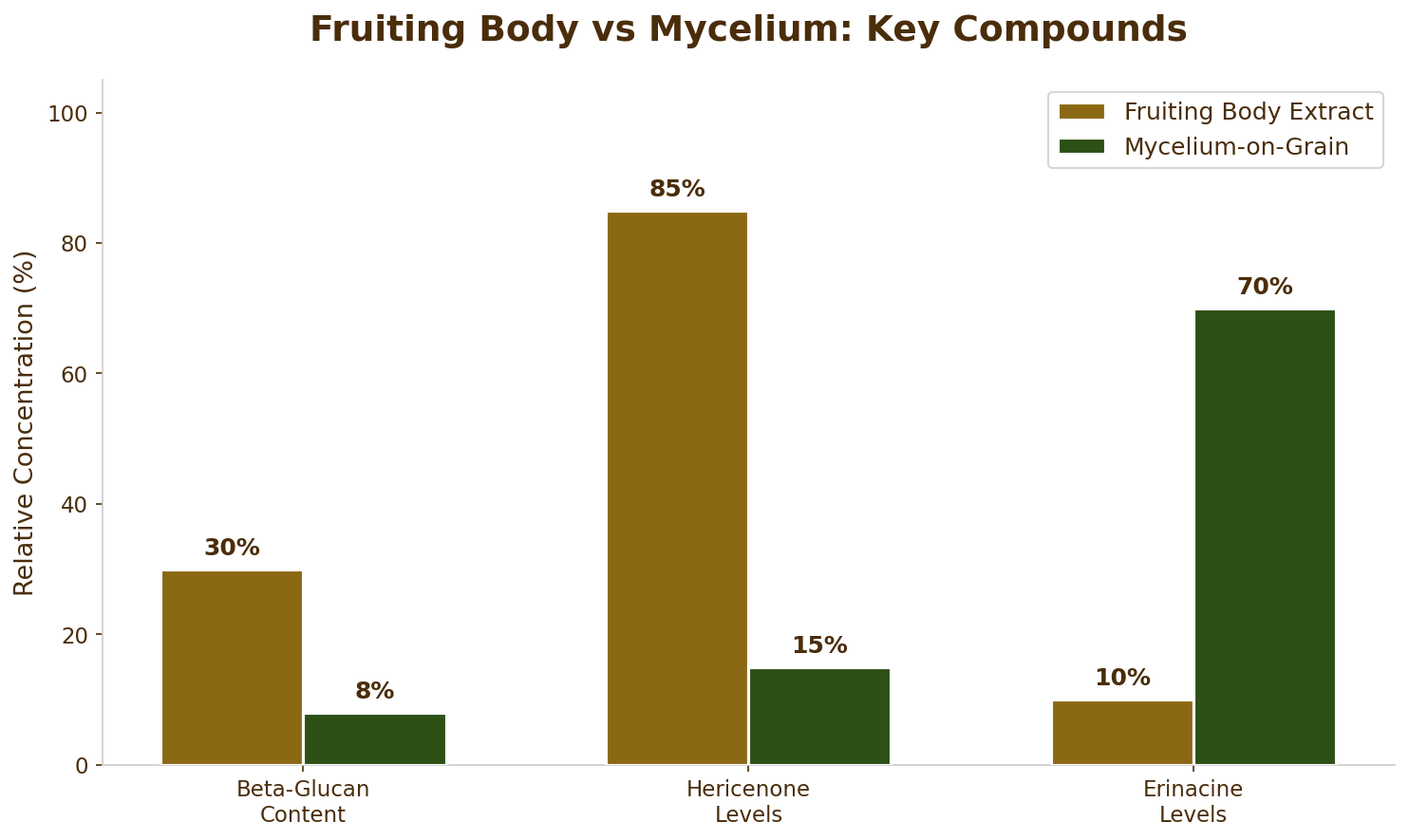
- Hericenones (found primarily in the fruiting body) — Research suggests these compounds may stimulate Nerve Growth Factor (NGF) production, a protein involved in the maintenance and growth of neurons.
- Erinacines (found primarily in the mycelium) — Some studies indicate these smaller molecules may be able to cross the blood-brain barrier, potentially allowing them to act more directly on neural tissue.
- Beta-glucans — Found in both parts, these polysaccharides are widely studied for their potential to support immune function. However, their concentration varies significantly depending on the part used and how the supplement is processed.
Both parts of the mushroom have value. The problem isn’t that mycelium is inherently inferior — it’s that the way most mycelium supplements are produced introduces a significant quality issue that rarely gets discussed on the label.
The Grain Substrate Problem: What Labels Often Hide
Here’s where things get complicated — and where your label is most likely failing you.
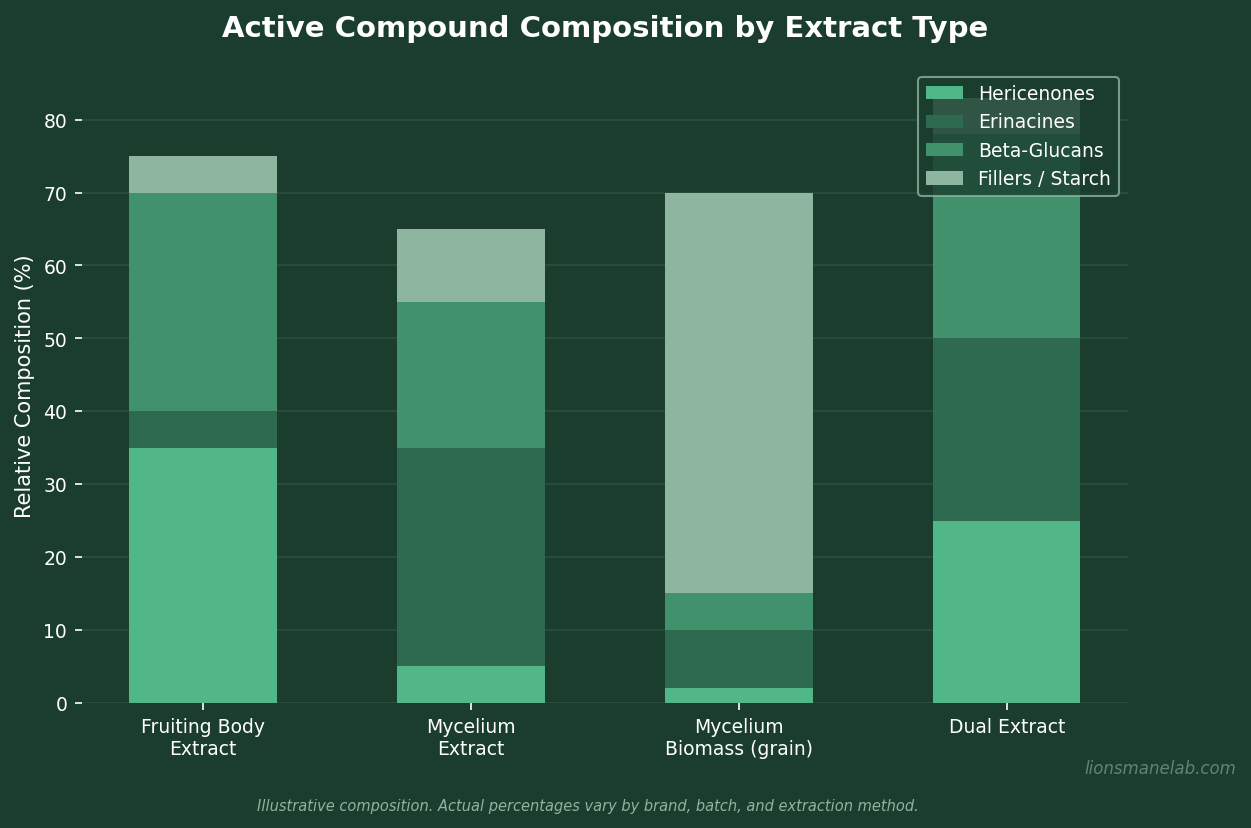
The majority of mycelium-based lion’s mane supplements sold in North America are produced using a method called grain fermentation. The mycelium is grown on a substrate of sterilized grain — typically rice, oats, or sorghum. As the mycelium colonizes the grain, it weaves itself into and around the grain kernels. When it’s time to harvest, the mycelium and grain are ground up together because separating them completely is impractical and cost-prohibitive.
The result? A product that contains a significant proportion of grain starch along with the mycelial material. Independent testing has shown that some mycelium-on-grain products contain starch levels exceeding 60% of the final product by weight. That’s grain filler — not bioactive mushroom compounds.
This is where label language becomes critically important. Watch for these terms:
- \”Myceliated grain\” or \”mycelial biomass\” — This typically means the product is mycelium grown on grain, ground together. The grain has not been separated or removed. You’re getting a mixture of fungal tissue and starch.
- \”Mycelium extract\” — This is a better indicator. The word \”extract\” suggests the bioactive compounds have been pulled from the mycelium using a solvent (usually hot water, alcohol, or both), concentrating the active ingredients and leaving much of the grain behind.
- \”Full spectrum\” or \”whole mushroom\” — These marketing terms sound comprehensive but are vague. They don’t tell you the ratio of fruiting body to mycelium, or whether grain substrate is included.
- \”Mushroom (Hericium erinaceus)\” — Check whether the Supplement Facts panel specifies \”fruiting body,\” \”mycelium,\” or both. If it just says the species name with no part specified, that’s a red flag.
A simple at-home test can reveal something about your supplement’s composition: mix a small amount of your mushroom powder into water and add a few drops of iodine. If the solution turns dark blue or black, the product contains a high level of starch — a hallmark of grain-based mycelium products that haven’t undergone proper extraction.
Why Fruiting Body Supplements Are Generally Preferred
Get Our Free Mushroom Supplement Guide
Lab-tested brands, dosage protocols, and quality markers — delivered free.
No spam. Unsubscribe anytime.
For consumers looking for standardized, measurable quality, fruiting body supplements tend to offer several advantages. This doesn’t mean they’re universally \”better\” — but they do provide more transparency and consistency.
Higher and more consistent beta-glucan content. Quality fruiting body extracts from brands like Real Mushrooms and Om Mushrooms — see our full supplement rankings routinely achieve beta-glucan levels above 25%, and many exceed 30%. This is because the fruiting body naturally concentrates these polysaccharides, and the extraction process further concentrates them. When you’re evaluating the best lion’s mane supplements, beta-glucan content is one of the most reliable quality markers available.
No grain filler dilution. Since the fruiting body grows above the substrate and is harvested separately, there’s no grain mixed into the final product. What you see on the label is what you get — pure mushroom material.
Established extraction methods. Fruiting body supplements benefit from centuries of traditional use and well-established hot water extraction methods that efficiently pull beta-glucans and hericenones from the mushroom tissue.
Easier third-party verification. Because fruiting body products have fewer variables (no grain contamination to account for), third-party testing and Certificates of Analysis (COAs) tend to be more straightforward and reliable.
Brands like Real Mushrooms [AFFILIATE LINK PLACEHOLDER: Real Mushrooms] have built their reputation on fruiting body extracts with verified beta-glucan content above 25%, third-party COAs, and transparent labeling. Om Mushrooms [AFFILIATE LINK PLACEHOLDER: Om Mushrooms] is another well-regarded option that uses organic fruiting bodies.
The Case for Mycelium: Erinacines and Proper Extraction
It would be a mistake to dismiss mycelium entirely. The unique compounds found in lion’s mane mycelium — particularly the erinacines — represent some of the most intriguing areas of current mushroom research.
Erinacines are diterpenoids that some studies indicate may cross the blood-brain barrier. This is significant because hericenones, found in the fruiting body, are larger molecules that may not pass this barrier as readily. Research in animal models suggests erinacines may support NGF synthesis directly within the brain, though human clinical data remains limited and individual results vary.
The key issue isn’t whether mycelium has value — it’s whether the mycelium product you’re buying actually delivers meaningful amounts of these compounds. A properly extracted mycelium product is fundamentally different from raw myceliated grain:
- Liquid fermentation (submerged cultivation) — Some manufacturers grow mycelium in liquid culture rather than on grain. This eliminates the grain starch problem entirely, producing pure mycelial material that can then be extracted and concentrated.
- Dual extraction of mycelium — Using both hot water and alcohol extraction can pull a broader range of compounds from the mycelium, including the alcohol-soluble erinacines and the water-soluble beta-glucans.
- Proper standardization — A quality mycelium extract will list specific compound levels and provide third-party testing to verify them, just as a good fruiting body extract does.
If you’re specifically interested in erinacines for their potential neurogenesis-supporting properties, a well-made mycelium extract may be worth considering — but you need to scrutinize the label and the manufacturer’s transparency far more carefully than you would with a fruiting body product.
Blended Products and the Host Defense Question
Some brands take a middle-ground approach, combining both fruiting body and mycelium in their formulations. The most well-known of these is Host Defense, founded by renowned mycologist Paul Stamets.
Host Defense uses a blend of fruiting body and mycelium in many of their products. The brand has built a strong reputation for consistent quality, and Stamets himself is one of the most respected figures in mycology. His advocacy for the \”full spectrum\” approach — using the entire organism — is rooted in the philosophy that the mushroom’s full range of compounds may work synergistically.
However, Host Defense does not publicly disclose the beta-glucan percentages in their products. This represents a transparency gap that makes it difficult for consumers to directly compare their products against fruiting body extracts that do publish this data. It’s worth noting that the absence of disclosure doesn’t necessarily indicate low beta-glucan content — it simply means you can’t verify it independently.
Host Defense [AFFILIATE LINK PLACEHOLDER: Host Defense] uses mycelium grown on organic brown rice, and the product does include the grain substrate. Their position is that the fermentation process transforms the grain in ways that create additional beneficial compounds. Some research supports the idea that the fermentation process produces unique metabolites, though this remains an area of ongoing study.
When evaluating blended products, consider asking:
- What is the ratio of fruiting body to mycelium?
- Is the beta-glucan content disclosed and verified by third-party testing?
- Is the mycelium grown on grain, and if so, is the grain separated or included?
- Does the manufacturer provide a Certificate of Analysis upon request?
How to Read Your Label: A Practical Checklist
Armed with the science, here’s how to evaluate any lion’s mane supplement on the shelf or online. These quality markers apply whether you’re choosing a fruiting body product, a mycelium extract, or a blend.
Check the Supplement Facts panel for:
- Part used — Does it specify \”fruiting body,\” \”mycelium,\” or both? If it doesn’t specify, be cautious.
- Beta-glucan content — Look for products listing greater than 25% beta-glucans. This is a strong indicator of a concentrated, properly extracted product.
- \”Extract\” vs. \”powder\” or \”biomass\” — Extracts have been processed to concentrate active compounds. Raw powders and biomass products may contain diluting material.
- Other ingredients — Watch for grain-based fillers like rice flour, rice starch, or maltodextrin listed beyond the active ingredients.
Look for quality certifications and transparency:
- Third-party Certificate of Analysis (COA) — Reputable brands make these available on their website or upon request. A COA from an independent lab verifies the product contains what the label claims.
- cGMP certification — Current Good Manufacturing Practices certification means the facility meets FDA manufacturing standards.
- Organic certification — While not a guarantee of potency, it indicates the product is free from synthetic pesticides and fertilizers.
- Starch and filler testing — Some brands proactively test for and disclose starch content, which is an excellent sign of transparency.
Understanding how to take lion’s mane properly also matters — even the best supplement won’t deliver results if dosing and timing aren’t right.
Frequently Asked Questions
Is fruiting body always better than mycelium for lion’s mane?
Not necessarily. Fruiting body products tend to offer more standardized and verifiable quality, particularly when it comes to beta-glucan content. However, the mycelium contains erinacines — compounds that some research suggests may cross the blood-brain barrier and support nerve growth factor production in ways that fruiting body hericenones may not. The issue is that many commercial mycelium products are grown on grain and diluted with starch. If you can find a properly extracted mycelium product (look for \”mycelium extract\” from liquid fermentation or dual extraction), it may offer unique benefits. For most consumers seeking a reliable, well-researched option, fruiting body extracts remain the safer choice.
How can I tell if my lion’s mane supplement contains grain filler?
Start with the label. If the Supplement Facts panel lists \”myceliated grain,\” \”mycelial biomass,\” or \”mycelium (Hericium erinaceus) grown on rice\” without the word \”extract,\” the product likely contains significant grain content. You can also look at the \”Other Ingredients\” section for rice flour, rice starch, or similar additives. For a quick at-home test, dissolve a small amount in water and add iodine — a dark blue-black reaction indicates high starch content. Finally, check whether the brand publishes beta-glucan percentages and third-party COAs. Products with greater than 25% verified beta-glucans typically have minimal grain dilution.
What does \”dual extract\” mean on a lion’s mane label?
Dual extraction refers to a process that uses both hot water and alcohol (ethanol) to pull different types of compounds from the mushroom. Hot water extraction is effective at dissolving beta-glucans and other water-soluble polysaccharides. Alcohol extraction captures compounds that aren’t water-soluble, including hericenones from the fruiting body and erinacines from the mycelium. A dual extract aims to deliver the broadest spectrum of bioactive compounds. When you see \”dual extract\” on a label, it generally indicates a more thorough processing method, though the quality still depends on the source material and the manufacturer’s standards.
Why doesn’t Host Defense list beta-glucan percentages?
Host Defense, the brand founded by mycologist Paul Stamets, does not publicly disclose the beta-glucan percentages in their products. The company has not provided a detailed public explanation for this decision. Their product philosophy emphasizes the value of the \”full spectrum\” of compounds in the whole mushroom organism, including the mycelium and the fermented grain substrate. While the brand maintains a strong reputation for consistent quality and Stamets is widely respected in the mycology community, the lack of disclosed beta-glucan data means consumers cannot directly compare Host Defense products against competitors that do publish this information. This remains a notable transparency gap in an otherwise reputable brand.
Can I take both fruiting body and mycelium supplements together?
Yes, some people choose to take both a fruiting body extract and a separate mycelium extract to capture the full range of lion’s mane compounds — hericenones from the fruiting body and erinacines from the mycelium. This approach may provide a more comprehensive profile of bioactive compounds than either alone. If you go this route, be mindful of your total lion’s mane dosage and choose quality products for each. A high-quality fruiting body extract paired with a properly extracted mycelium product (not myceliated grain) would be the ideal combination. As always, individual results vary, and it’s wise to consult with a healthcare provider before starting any new supplement regimen.
Making an Informed Choice
The fruiting body vs. mycelium debate isn’t about declaring a universal winner. It’s about understanding what you’re actually buying and ensuring the product delivers meaningful levels of the compounds you’re after. The science is nuanced, but the practical advice is straightforward:
- For most people, a fruiting body extract with verified beta-glucan content above 25% and a third-party COA is the most reliable choice. It eliminates the grain filler concern and provides well-documented bioactive compounds.
- For those specifically interested in erinacines, seek out properly extracted mycelium products — not myceliated grain — and verify the manufacturer’s quality claims independently.
- For a comprehensive approach, consider a dual-extracted product or a combination of both fruiting body and mycelium extracts from transparent, reputable brands.
Whatever you choose, the most important step is reading your label critically. Don’t settle for vague marketing language. Look for specific compound data, verified testing, and clear identification of the mushroom parts used. Your brain health is worth the extra minute of label reading.
Ready to find a supplement that meets these quality standards? Explore our guide to the best lion’s mane supplements for detailed brand comparisons, lab-verified data, and recommendations based on your specific goals.
References
- Wu T, et al. “Comparison of bioactive compounds and bioactivities of mycelia and fruiting bodies of Hericium erinaceus.” Journal of Functional Foods, 2014.
- Spelman K, et al. “Neurological Activity of Lion’s Mane (Hericium erinaceus).” Journal of Restorative Medicine, 2017.
- Lion’s Mane — Examine.com Evidence-Based Research Summary
- WebMD: Hericium Erinaceus (Lion’s Mane) — Uses, Side Effects, and More