Why Build a Functional Mushroom Stack for Cognitive Performance?
No single compound does everything for your brain. Neurotransmitter production, nerve growth factor signaling, stress regulation, mitochondrial energy, and immune defense all run on different systems. A thoughtfully assembled stack of functional mushrooms and nootropics can address several of these pathways simultaneously, creating a broader foundation for mental performance than any single supplement alone.
In This Article
- Why Build a Functional Mushroom Stack for Cognitive Performance?
- Lion’s Mane: The Cognitive Cornerstone of Any Mushroom Stack
- Lion’s Mane Dosage for Stacking
- Complementary Functional Mushrooms: Cordyceps, Reishi, and Chaga
- Cordyceps: Energy and Oxygen Utilization
- Reishi: The Sleep and Stress Regulator
- Chaga: Antioxidant Defense and Immune Support
- Non-Mushroom Nootropics That Amplify Your Stack
- Alpha-GPC: Fueling the Acetylcholine System
- Bacopa Monnieri: Long-Term Memory Consolidation
- Rhodiola Rosea: Cognitive Fatigue Resistance
- Ashwagandha: Stress Axis and Sleep Quality
- Beginner, Intermediate, and Advanced Stack Recommendations
- Beginner Stack: The Foundation
- Intermediate Stack: Adding the Mushroom Trio
- Advanced Stack: The Full Protocol
- Timing, Cycling, and Practical Tips for Your Stack
- Morning vs. Evening Dosing
- Cycling Your Stack
- Food and Absorption
- How Long Before You Notice Results?
- Frequently Asked Questions
- Can I take all these mushrooms and nootropics together safely?
- What is the most important supplement in a cognitive mushroom stack?
- How much does a full functional mushroom stack cost per month?
- Should I take mushroom extracts or whole mushroom powder?
- Do I need to cycle lion’s mane or can I take it every day?
- Building Your Stack: Start Today, Optimize Over Time
- References
In this guide, we will build a functional mushroom stack from the ground up, starting with lion’s mane as the cognitive cornerstone, then layering in complementary mushrooms and evidence-backed nootropics. Whether you are a beginner or an experienced biohacker, you will find tiered stack recommendations you can start using today.
Lion’s Mane: The Cognitive Cornerstone of Any Mushroom Stack
Every serious mushroom stack starts with lion’s mane (Hericium erinaceus). It contains two unique families of bioactive compounds: hericenones (found in the fruiting body) and erinacines (found in the mycelium). Both are associated with stimulating Nerve Growth Factor (NGF) synthesis in preclinical research. NGF is a protein your brain uses to maintain, repair, and grow neurons, and research suggests supporting its production may help sustain cognitive function and neural plasticity. For more on this mechanism, see our article on lion’s mane and neurogenesis.
When selecting lion’s mane for your stack, look for 100% fruiting body extracts with verified beta-glucan content above 25%, or dual-extract formulations. Third-party testing and a Certificate of Analysis should be available. Brands like Real Mushrooms [AFFILIATE LINK PLACEHOLDER: REAL MUSHROOMS] set the standard with transparent, verified beta-glucan percentages.
Lion’s Mane Dosage for Stacking
Most available research and user reports point to a range of 500mg to 2,000mg per day of a quality extract. If you are stacking lion’s mane with other compounds, starting at the lower end (500mg to 1,000mg) is a reasonable approach so you can isolate how each new ingredient affects you. For a thorough breakdown of dosing strategies, check out our lion’s mane dosage guide.
Complementary Functional Mushrooms: Cordyceps, Reishi, and Chaga
Get Our Free Mushroom Supplement Guide
Lab-tested brands, dosage protocols, and quality markers — delivered free.
No spam. Unsubscribe anytime.
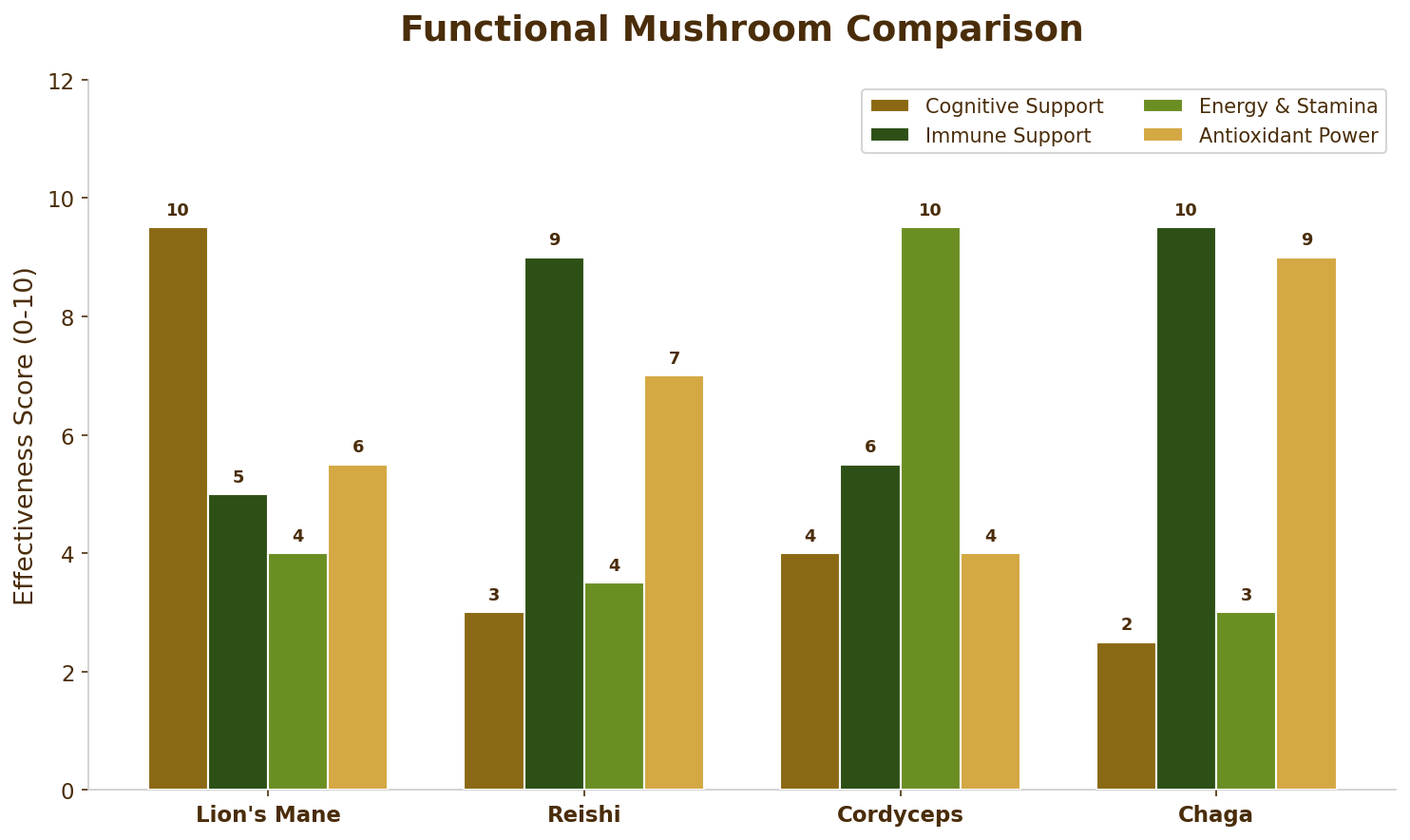
Lion’s mane handles the neurogenesis and cognitive clarity angle. But a complete functional mushroom stack benefits from addressing energy, stress, sleep, and immune resilience as well. Three mushrooms fill those gaps effectively.
Cordyceps: Energy and Oxygen Utilization
Cordyceps (Cordyceps militaris) is the energy mushroom. Research suggests it may support mitochondrial function, oxygen utilization, and ATP production at the cellular level. For cognitive performance, that translates to better sustained mental energy during long work sessions. It pairs perfectly with lion’s mane: where lion’s mane works on neural growth, cordyceps targets raw energy supply. A common protocol is 1,000mg to 2,000mg taken in the morning.
Related: Cordyceps Mushroom Benefits
Reishi: The Sleep and Stress Regulator
Reishi (Ganoderma lucidum) is the counterbalance mushroom. Research suggests it may support sleep quality and modulate the body’s stress response through its triterpene content. Sleep matters in a cognitive stack because memory consolidation and neural repair happen primarily during deep sleep. If your stack boosts NGF during the day but you sleep poorly, you undermine half the benefit. Reishi at 500mg to 1,500mg in the evening rounds out the 24-hour cycle.
Chaga: Antioxidant Defense and Immune Support
Chaga (Inonotus obliquus) earns its place through antioxidant and immune-supporting properties. Oxidative stress is a key factor associated with age-related cognitive decline, so chaga may help protect the neurons lion’s mane is helping to maintain. Its high beta-glucan content also supports a balanced immune system, and since chronic low-grade inflammation has been linked to brain fog in some studies, immune support is a legitimate cognitive strategy.
Non-Mushroom Nootropics That Amplify Your Stack
Mushrooms provide a powerful base, but the best cognitive stacks also integrate nootropics that target neurotransmitter systems and stress pathways mushrooms do not directly address.
Alpha-GPC: Fueling the Acetylcholine System
Alpha-GPC is a bioavailable choline source that supports acetylcholine production, the neurotransmitter most associated with learning, memory, and focused attention. The synergy with lion’s mane is compelling: lion’s mane supports NGF and neural growth, while Alpha-GPC provides the raw material for the neurotransmitter those neurons use to communicate. Research suggests 300mg to 600mg per day may support cognitive function, and many users report the combination with lion’s mane is more effective than either alone, though individual results vary.
Bacopa Monnieri: Long-Term Memory Consolidation
Bacopa monnieri is an Ayurvedic herb with growing research supporting its role in memory consolidation. Like lion’s mane, it is a slow-build compound requiring at least eight weeks of daily use. At 300mg to 450mg of a standardized extract (50% bacosides), bacopa complements lion’s mane through different mechanisms: where lion’s mane works through NGF, bacopa research points toward serotonergic and antioxidant activity in the hippocampus.
Rhodiola Rosea: Cognitive Fatigue Resistance
Rhodiola rosea is an adaptogenic herb that research suggests may support resistance to cognitive fatigue and stress. Some studies indicate it may modulate cortisol and support dopamine signaling under pressure. At 200mg to 400mg of a standardized extract (3% rosavins, 1% salidroside), rhodiola adds cognitive resilience that is particularly useful for knowledge workers dealing with deadline pressure and long hours.
Ashwagandha: Stress Axis and Sleep Quality
Ashwagandha (Withania somnifera) addresses the stress-performance connection. Research suggests it may help lower cortisol and support sleep quality, both with downstream effects on cognitive performance. Unlike rhodiola, ashwagandha’s primary benefit is in sleep architecture, pairing naturally with evening reishi. A common dose is 300mg to 600mg of a KSM-66 or Sensoril extract taken in the evening.
Related: Ashwagandha And Lion’S Mane Stack
Beginner, Intermediate, and Advanced Stack Recommendations
Building your stack progressively lets you isolate what works, identify sensitivities, and dial in dosing. Here are three tiers.
Beginner Stack: The Foundation
Start here if you have never taken functional mushrooms or nootropics before. Run this for a minimum of four to six weeks before adding anything.
- Lion’s Mane: 1,000mg per day (morning, with food). Use a quality fruiting body extract like Real Mushrooms [AFFILIATE LINK PLACEHOLDER: REAL MUSHROOMS].
- Alpha-GPC: 300mg per day (morning). Supports the acetylcholine system that lion’s mane is helping to build.
This two-compound stack is simple, well-tolerated, and gives you a clear baseline. Track your focus, memory, and energy levels in a simple daily journal so you have data when you decide to expand.
Intermediate Stack: Adding the Mushroom Trio
After four to six weeks on the beginner stack, layer in complementary mushrooms and one adaptogen. Onnit’s Shroom Tech line [AFFILIATE LINK PLACEHOLDER: ONNIT] offers convenient options for cordyceps supplementation.
- Lion’s Mane: 1,000mg to 1,500mg per day (morning)
- Alpha-GPC: 300mg to 600mg per day (morning)
- Cordyceps: 1,000mg per day (morning, for energy support)
- Reishi: 500mg to 1,000mg per day (evening, for sleep and stress)
- Rhodiola Rosea: 200mg per day (morning, for fatigue resistance)
This five-compound stack covers the daytime cognitive and energy axis (lion’s mane, Alpha-GPC, cordyceps, rhodiola) and the nighttime recovery axis (reishi). Give this configuration at least another four weeks before moving to the advanced tier.
Advanced Stack: The Full Protocol
This is the comprehensive stack for experienced users who have already established their baseline and know how they respond to each individual component. Four Sigmatic [AFFILIATE LINK PLACEHOLDER: FOUR SIGMATIC] offers mushroom coffee blends that can simplify your morning routine when combining multiple mushroom extracts.
- Lion’s Mane: 1,500mg to 2,000mg per day (morning)
- Alpha-GPC: 600mg per day (morning)
- Cordyceps: 1,500mg to 2,000mg per day (morning)
- Chaga: 500mg to 1,000mg per day (morning, for antioxidant support)
- Bacopa Monnieri: 300mg per day standardized extract (morning, with fat source for absorption)
- Rhodiola Rosea: 400mg per day (morning)
- Reishi: 1,000mg to 1,500mg per day (evening)
- Ashwagandha (KSM-66): 300mg to 600mg per day (evening)
This eight-compound stack addresses NGF and neuroplasticity (lion’s mane), neurotransmitter support (Alpha-GPC), cellular energy (cordyceps), antioxidant defense (chaga), memory consolidation (bacopa), stress resilience (rhodiola), and sleep quality (reishi and ashwagandha). It is a full-spectrum approach to cognitive performance.
Timing, Cycling, and Practical Tips for Your Stack
Knowing what to take is only half the equation. How and when you take your stack matters as well.
Morning vs. Evening Dosing
As a general rule, stimulating or energizing compounds go in the morning and calming or restorative compounds go in the evening. Lion’s mane, cordyceps, Alpha-GPC, rhodiola, bacopa, and chaga are all morning candidates. Reishi and ashwagandha are better suited for evening use. Taking reishi or ashwagandha in the morning may cause unwanted drowsiness, while taking cordyceps or rhodiola in the evening may interfere with sleep.
Cycling Your Stack
There is ongoing debate about whether functional mushrooms and nootropics need to be cycled. The general consensus among experienced users is that adaptogens like rhodiola and ashwagandha benefit from cycling, such as five days on and two days off, or four weeks on and one week off. Lion’s mane and other functional mushrooms appear to be well-tolerated with continuous daily use based on available research, though some users prefer to cycle all compounds as a precaution.
Food and Absorption
Most mushroom extracts are best taken with food. Bacopa monnieri in particular benefits from co-ingestion with a fat source, as its active bacosides are fat-soluble. Alpha-GPC can be taken with or without food. If you experience any digestive discomfort from your stack, spreading your morning doses across breakfast and lunch often resolves the issue.
How Long Before You Notice Results?
Set realistic expectations. Most users in available studies report noticeable effects from lion’s mane in two to four weeks of consistent daily use. Bacopa typically requires a full eight weeks. Cordyceps and rhodiola tend to produce faster-onset effects, sometimes within the first week. The full benefits of a comprehensive stack often become most apparent after two to three months of consistent use. For more on what to expect, read our guide on lion’s mane for brain fog.
Frequently Asked Questions
Can I take all these mushrooms and nootropics together safely?
The compounds discussed in this guide are generally well-tolerated and have long histories of use individually. However, combining multiple active compounds increases the variables your body is processing. Start with the beginner stack and add one new compound at a time, waiting at least two weeks between additions so you can attribute any effects or side effects accurately. Always consult your healthcare provider before starting any new supplement protocol, particularly if you take prescription medications, blood thinners, or immunosuppressants.
What is the most important supplement in a cognitive mushroom stack?
Lion’s mane is the cornerstone for a reason. Its unique ability to support NGF production through hericenones and erinacines is not replicated by any other commonly available supplement. If you had to choose only one compound, lion’s mane would be the strongest starting point for cognitive performance. Pair it with Alpha-GPC for neurotransmitter support and you have covered two of the most important cognitive pathways with just two supplements. See our full breakdown of the best lion’s mane supplements to choose the right product.
How much does a full functional mushroom stack cost per month?
The beginner stack (lion’s mane plus Alpha-GPC) typically runs between $30 and $50 per month using quality products. The intermediate stack adds cordyceps, reishi, and rhodiola, bringing the monthly cost to approximately $60 to $90. The advanced stack with all eight compounds can run $100 to $150 per month depending on brands and dosages. Buying in bulk, choosing powder over capsules, and watching for subscription discounts from brands like Real Mushrooms [AFFILIATE LINK PLACEHOLDER: REAL MUSHROOMS] can reduce costs significantly.
Should I take mushroom extracts or whole mushroom powder?
Extracts are generally preferred for a cognitive performance stack. Hot water extraction or dual extraction concentrates the active compounds, particularly beta-glucans, hericenones, and triterpenes, while removing indigestible chitin from the cell walls. Whole mushroom powder retains more fiber and broader nutritional content but delivers lower concentrations of the specific bioactive compounds you are stacking for. Look for products that state the extraction method and beta-glucan percentage on the label.
Do I need to cycle lion’s mane or can I take it every day?
Based on available research and widespread user experience, lion’s mane appears to be well-tolerated with continuous daily use. Unlike some adaptogens where cycling is commonly recommended, there is no strong evidence suggesting lion’s mane requires periodic breaks. That said, some users choose to cycle all their supplements on a schedule such as five days on and two days off. If you are unsure, consult your healthcare provider for personalized guidance.
Building Your Stack: Start Today, Optimize Over Time
The best functional mushroom stack is the one you actually take consistently. Start with lion’s mane and Alpha-GPC as your foundation. Give it a month. Track your results. Then layer in cordyceps for energy, reishi for sleep, and an adaptogen like rhodiola for stress resilience. Over two to three months, you can build toward the full advanced protocol if your body responds well and your goals call for it.
The research on functional mushrooms and nootropics for cognitive performance is still evolving, but the existing evidence and decades of traditional use provide a compelling foundation. By stacking compounds that target different cognitive pathways, you give yourself the broadest possible base of support for focus, memory, mental energy, and long-term brain health.
Remember: individual results vary, consistency matters more than perfection, and you should always consult your healthcare provider before making significant changes to your supplement routine.
References
- Wachtel-Galor S, et al. “Herbal Medicine: Biomolecular and Clinical Aspects — Ganoderma lucidum (Lingzhi or Reishi): A Medicinal Mushroom.” CRC Press/Taylor & Francis, 2011.
- Friedman M. “Chemistry, Nutrition, and Health-Promoting Properties of Hericium erinaceus (Lion’s Mane) Mushroom Fruiting Bodies and Mycelia and Their Bioactive Compounds.” Journal of Agricultural and Food Chemistry, 2015.
- Examine.com: Cognitive Function — Evidence-Based Nootropic Research
- Healthline: Functional Mushroom Benefits and Research