
The Short Answer: 2 to 8 Weeks, Depending on What You’re Measuring
If you’re searching for how long lion’s mane takes to work, you probably want a number. Here it is: most users report noticing initial effects within 2 to 4 weeks of consistent daily use, with more substantial benefits building over 4 to 8 weeks.
In This Article
- The Short Answer: 2 to 8 Weeks, Depending on What You’re Measuring
- Why Lion’s Mane Isn’t Instant: The NGF Pathway
- Week-by-Week Timeline: What to Realistically Expect
- Week 1-2: The Build Phase
- Week 2-4: First Subtle Signs
- Week 4-8: The Research-Supported Window
- 8+ Weeks: Maintenance and Continued Building
- Factors That Affect How Quickly You Notice Effects
- What You Should Actually Track
- Common Mistakes That Sabotage Results
- How to Set Yourself Up for Success
- 1. Pick a Quality Extract
- 2. Commit to Eight Weeks Minimum
- 3. Take It at the Same Time Daily
- 4. Track Specific Metrics
- 5. Support the Biology
- Frequently Asked Questions
- Can you feel lion’s mane working immediately?
- What if I don’t notice anything after eight weeks?
- Does lion’s mane work faster at higher doses?
- Do I need to take lion’s mane forever?
- The Bottom Line
- References
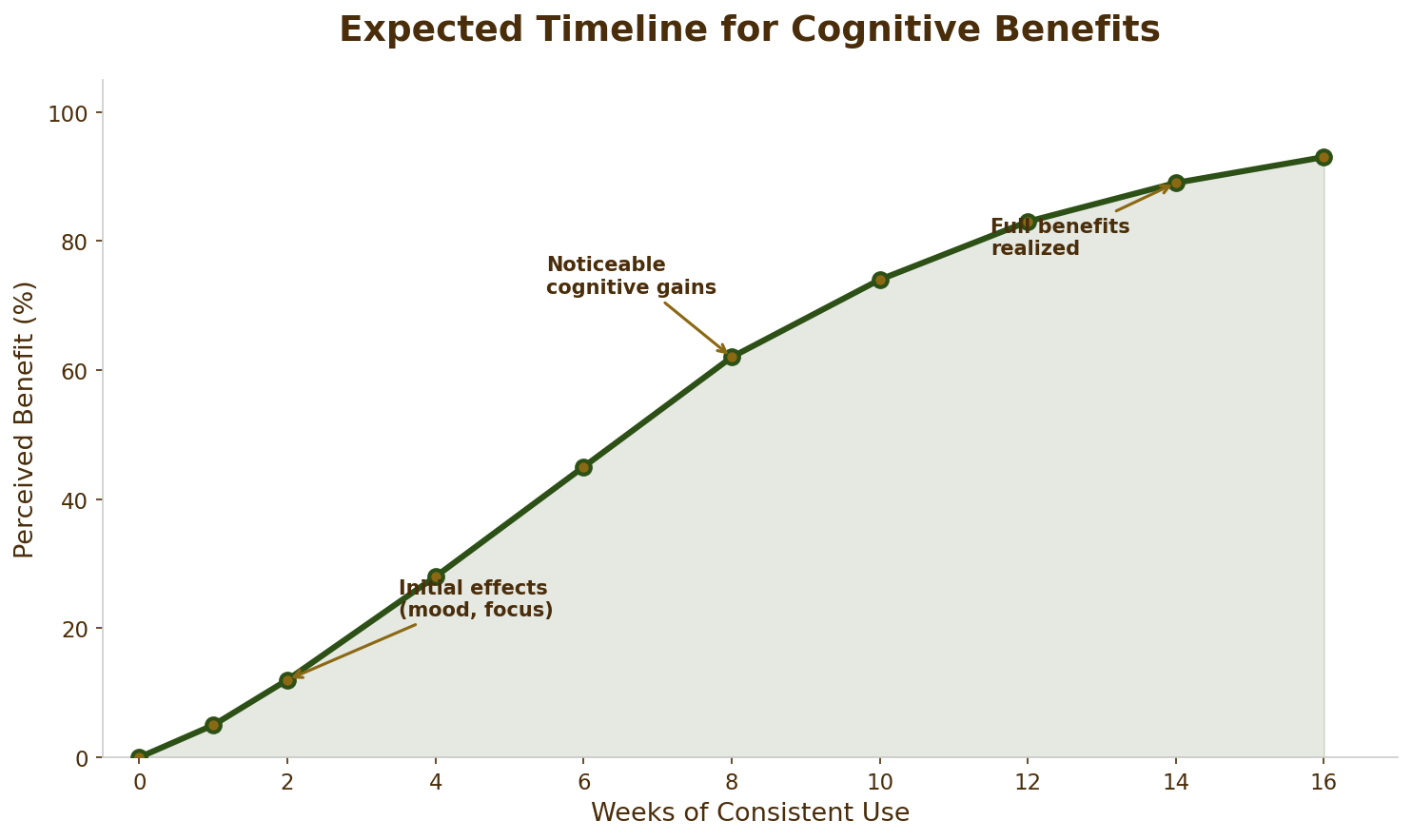
But that range deserves context, because lion’s mane (Hericium erinaceus) is not caffeine. There is no single moment where it “kicks in.” The effects are gradual, cumulative, and often subtle enough that you might not recognize them unless you’re paying attention. Individual variation is significant — your age, baseline cognitive state, dosage, and supplement quality all influence the timeline.
The clinical research that exists typically runs 8 to 16 weeks, which tells you something about the researchers’ expectations. Nobody is designing lion’s mane studies with a 3-day intervention window, because the mechanism of action doesn’t work that way. For a complete overview of what this mushroom can do, see our lion’s mane benefits guide.
Why Lion’s Mane Isn’t Instant: The NGF Pathway
Caffeine works by blocking adenosine receptors, producing a rapid shift in alertness. Prescription stimulants flood your synapses with dopamine and norepinephrine. These are acute neurotransmitter effects. You feel them within 20 to 45 minutes because they’re manipulating existing signaling chemistry.
Lion’s mane works through an entirely different mechanism. Its key bioactive compounds — hericenones (found in the fruiting body) and erinacines (found in the mycelium) — stimulate the production of Nerve Growth Factor (NGF). NGF is a protein that supports the growth, maintenance, and survival of neurons. It is essential for neurogenesis and neuroplasticity — the brain’s ability to form new neural connections and strengthen existing ones.
This is not a light switch. It is infrastructure work. Think of it as upgrading the wiring in your house rather than flipping on a brighter bulb. The neurons need time to respond to increased NGF levels, form new connections, and strengthen synaptic pathways. This biological process cannot be rushed, which is why research suggests the benefits build gradually with consistent use.
This is also why lion’s mane does not produce a “buzz,” a crash, or any of the acute sensations associated with stimulants. If you’re expecting that, you may quit before the compound has had time to do its actual work.
Week-by-Week Timeline: What to Realistically Expect
Get Our Free Mushroom Supplement Guide
Lab-tested brands, dosage protocols, and quality markers — delivered free.
No spam. Unsubscribe anytime.
Based on available research and widely reported user experiences, here is a typical lion’s mane timeline when taking a consistent daily dose of a quality extract. Individual results vary, and this is a general framework rather than a guarantee.
Week 1-2: The Build Phase
Most people notice nothing during this period. This is completely normal. The bioactive compounds are entering your system, and the early stages of NGF upregulation are underway, but the effects have not accumulated enough to cross the threshold of awareness.
This is the phase where most people who will eventually quit make the decision to stop. They take lion’s mane for five or ten days, feel no dramatic change, and conclude it doesn’t work. They are evaluating a neuroplasticity compound on a stimulant timeline.
Week 2-4: First Subtle Signs
Around the two to four week mark, some users begin to notice subtle shifts:
- Slightly easier word recall during conversation
- Marginally longer focus sessions before mental fatigue sets in
- A reduction in brain fog episodes
- A sense that thinking feels “cleaner” — not faster, but less cluttered
These changes are often subtle enough that you might attribute them to a good night’s sleep rather than the supplement. This is why tracking specific metrics matters.
Week 4-8: The Research-Supported Window
This is where most clinical studies begin measuring outcomes. By week four to eight, the cumulative effects of consistent NGF stimulation may produce more clearly noticeable improvements: sustained focus during demanding tasks, improved verbal fluency, reduced frequency of losing your train of thought, and better mental endurance during long work sessions.
The Mori et al. (2009) study found that older adults with mild cognitive impairment showed significantly improved cognitive function scores after 8 weeks, with continued improvement at 16 weeks. The Saitsu et al. (2019) trial found improvements in healthy adults after 12 weeks. These timeframes are consistent with a compound that works through gradual neurobiological mechanisms.
8+ Weeks: Maintenance and Continued Building
Beyond eight weeks, many long-term users report that benefits continue to deepen, though the rate of noticeable change typically slows. One important finding from Mori et al.: when participants stopped taking lion’s mane after 16 weeks, their cognitive scores declined over the following four weeks. This suggests the benefits require ongoing supplementation to maintain.
Many long-term users report that the benefits become their new baseline — they only notice the difference when they stop.
Factors That Affect How Quickly You Notice Effects
Several variables influence your personal timeline:

- Dosage: Higher doses within the studied range (1,000mg to 3,000mg daily) may produce noticeable effects sooner. See our lion’s mane dosage guide for research-backed recommendations.
- Extract quality: A properly extracted fruiting body supplement with verified beta-glucan content is not the same as raw mushroom powder or a grain-diluted mycelium product. Quality varies enormously across brands.
- Consistency: Daily use matters. Sporadic dosing prevents the cumulative NGF buildup that appears to drive the benefits. Three times a week is not equivalent to every day.
- Individual biology: Age, genetics, gut microbiome, and overall neurological health all influence response time. Someone with significant brain fog may notice changes sooner simply because there is more room for perceptible improvement.
- Supporting factors: Sleep quality, stress levels, exercise habits, and diet all influence your brain’s ability to respond to NGF stimulation. Lion’s mane is not working in isolation.
What You Should Actually Track
One of the biggest mistakes people make is waiting for a single “aha” moment — a sudden shift where everything clicks. That is a stimulant expectation applied to a neuroplasticity compound. Instead, track specific metrics over time:
- Focus duration: How long can you work on a demanding task before your mind wanders?
- Brain fog frequency: How many times per week do you experience that hazy, can’t-think-clearly feeling?
- Verbal fluency: Are you finding words more easily in conversation?
- Sleep quality: Some users report improved sleep. Track how rested you feel on waking.
- Mental endurance: Is the afternoon cognitive dropoff less severe than it used to be?
A simple method: rate your cognitive performance on a 1-10 scale at the end of each workday. After four weeks, look at the trend. This removes day-to-day noise and reveals the gradient of change you might otherwise miss.
Common Mistakes That Sabotage Results
If lion’s mane “isn’t working” for you, one of these issues is likely the cause:
- Expecting stimulant effects: Lion’s mane will never feel like caffeine or Adderall. If that’s your benchmark, you will always conclude it failed.
- Quitting at week two: The most common failure point. Two weeks is barely enough time for NGF pathways to begin responding. You are pulling the plant out of the soil to check if the roots are growing.
- Inconsistent dosing: A few days on, a few days off prevents the cumulative buildup that drives results.
- Using low-quality supplements: A grain-grown mycelium product with no extraction process is fundamentally different from a concentrated fruiting body extract. Our best lion’s mane supplement guide breaks down what to look for.
- Ignoring foundational health: No supplement will override chronic sleep deprivation, severe stress, or an underlying medical condition. Consult a healthcare provider if brain fog is persistent and severe.
How to Set Yourself Up for Success
1. Pick a Quality Extract
Choose a supplement that uses fruiting body extract, has verified beta-glucan content, and provides third-party certificates of analysis. Real Mushrooms is one brand that meets these criteria with transparent testing and standardized extraction. Check current Real Mushrooms pricing here.
2. Commit to Eight Weeks Minimum
Do not evaluate the supplement before the eight-week mark. Write the date on your calendar. Everything before that is the build phase.
3. Take It at the Same Time Daily
Consistency matters for compliance and may matter for maintaining steady levels of active compounds. Many users take lion’s mane in the morning with breakfast; others split the dose between morning and afternoon. For detailed guidance, see our guide on how to take lion’s mane.
4. Track Specific Metrics
Use the tracking approach outlined above. Rate your cognitive performance daily, note brain fog episodes, and time your focus sessions. Without data, you’re relying on vague impressions — and vague impressions are unreliable over multi-week timescales.
5. Support the Biology
Prioritize sleep (7-9 hours), manage stress, stay hydrated, and exercise regularly. Lion’s mane may support NGF production, but your brain needs the right conditions to act on that support.
Frequently Asked Questions
Can you feel lion’s mane working immediately?
No. Its mechanism of action — NGF stimulation and gradual neuroplastic change — requires weeks of consistent use before most people notice any difference. If a product claims instant effects, that claim does not align with how lion’s mane works biologically.
What if I don’t notice anything after eight weeks?
Verify your supplement quality, confirm you’ve been consistent with daily dosing, and consider whether your dose is sufficient (1,000mg to 3,000mg daily). Individual response varies, and the absence of dramatic subjective effects does not necessarily mean zero biological activity.
Does lion’s mane work faster at higher doses?
Some users report noticing effects sooner at higher doses, but this has not been studied in a rigorous dose-response trial. Starting at a moderate dose (around 1,000mg) and adjusting based on response is a reasonable approach. Quality of extract matters more than raw milligrams.
Do I need to take lion’s mane forever?
Available evidence suggests benefits may require ongoing supplementation. The Mori et al. (2009) study found cognitive improvements reversed after participants stopped. Many long-term users treat it as part of their daily routine, like fish oil.
The Bottom Line
Lion’s mane works on a biological timeline, not a pharmaceutical one. Expect nothing for the first one to two weeks. Look for subtle shifts around weeks two to four. Evaluate honestly at the eight-week mark. The mechanism — NGF stimulation, neuroplasticity, gradual neural infrastructure improvement — is fundamentally different from anything that produces instant results.
The people who get the most from lion’s mane treat it like what it is: a long-term investment in cognitive support, not a quick fix. Pick a quality extract, take it daily, track what matters, and give the biology time to work.
These statements have not been evaluated by the Food and Drug Administration. This product is not intended to diagnose, treat, cure, or prevent any disease. Always consult your healthcare provider before starting any supplement regimen.
This article contains affiliate links. If you purchase through these links, we may earn a commission at no additional cost to you. This does not influence our editorial content or recommendations.
References
- Mori K, et al. “Improving effects of the mushroom Yamabushitake (Hericium erinaceus) on mild cognitive impairment: a double-blind placebo-controlled clinical trial.” Phytotherapy Research, 2009.
- Nagano M, et al. “Reduction of depression and anxiety by 4 weeks Hericium erinaceus intake.” Biomedical Research, 2010.
- Lion’s Mane Timeline and Effects — Examine.com Research Summary
- WebMD: Hericium Erinaceus (Lion’s Mane) — Overview