If you or your child has ADHD, you have probably encountered lion’s mane mushroom (Hericium erinaceus) in the growing conversation around natural cognitive support. For research on lion’s mane and mental clarity and brain fog, see our dedicated guide. Online communities and supplement brands increasingly mention lion’s mane and ADHD together — often with more confidence than the evidence warrants.
In This Article
- Why Is Lion’s Mane Being Studied for Cognitive Function?
- What Does the Research Actually Show?
- The Mori 2009 Study
- Preclinical Evidence
- The Critical Gap
- How Might Lion’s Mane Support Focus and Attention?
- NGF and Neural Connectivity
- Anti-Inflammatory Pathways
- Gut-Brain Axis
- What Lion’s Mane Cannot Do
- Practical Considerations
- Dosage
- Timeline
- Quality Markers
- Safety
- Stacking Considerations
- Bottom Line
- References
The honest starting point: no clinical trial has specifically studied lion’s mane for ADHD. What does exist is preclinical research on lion’s mane and cognitive function — including focus, memory, and neuroplasticity — that has led some researchers to wonder whether it might play a supporting role. For a comparison of which mushrooms may support cognitive function most effectively, see our guide to the best mushrooms for brain health. That distinction between “wonder whether” and “proven to help” matters enormously, and this article will maintain it throughout.
If you or your child has been diagnosed with ADHD, your healthcare provider should be the starting point for any treatment decisions. What follows is an evidence-based overview of what we currently know — and do not know — about lion’s mane as it relates to attention and focus.
Why Is Lion’s Mane Being Studied for Cognitive Function?
Lion’s mane has attracted scientific interest primarily because of two families of bioactive compounds: hericenones and erinacines.
Hericenones are found in the fruiting body and have been shown in laboratory studies to stimulate the production of Nerve Growth Factor (NGF). NGF is a protein critical for the growth, maintenance, and survival of neurons. It supports the formation of new neural connections and helps existing neurons communicate more efficiently.
Erinacines are found in the mycelium and are notable because they are small enough to cross the blood-brain barrier, meaning they can potentially influence NGF production directly within the central nervous system. For a detailed exploration of how these compounds work, see our guide on lion’s mane and neurogenesis.
The broader concept here is neuroplasticity — the brain’s ability to reorganize, form new connections, and adapt. NGF is a key driver of neuroplastic processes. Because ADHD involves differences in neural connectivity and executive function, some researchers have hypothesized that compounds supporting neuroplasticity could theoretically play a complementary role. However, this hypothesis has not been tested in controlled human trials specific to ADHD.
What Does the Research Actually Show?
Separating what has been demonstrated from what has been assumed is essential when evaluating lion’s mane for any cognitive application, especially one as complex as ADHD.
The Mori 2009 Study
The most frequently cited human trial is Mori et al. (2009), a double-blind, placebo-controlled study published in Phytotherapy Research. Older adults with mild cognitive impairment who took lion’s mane extract for 16 weeks showed improved cognitive function scores versus placebo. When supplementation stopped, scores declined — suggesting ongoing use may be required.
This study is important but must be contextualized carefully: the participants had mild cognitive impairment, not ADHD. They were older adults, not children or younger adults with attention difficulties. The cognitive improvements measured — primarily on a general cognitive function scale — do not map directly onto ADHD symptoms like impulsivity, hyperactivity, or sustained attention deficits.
Preclinical Evidence
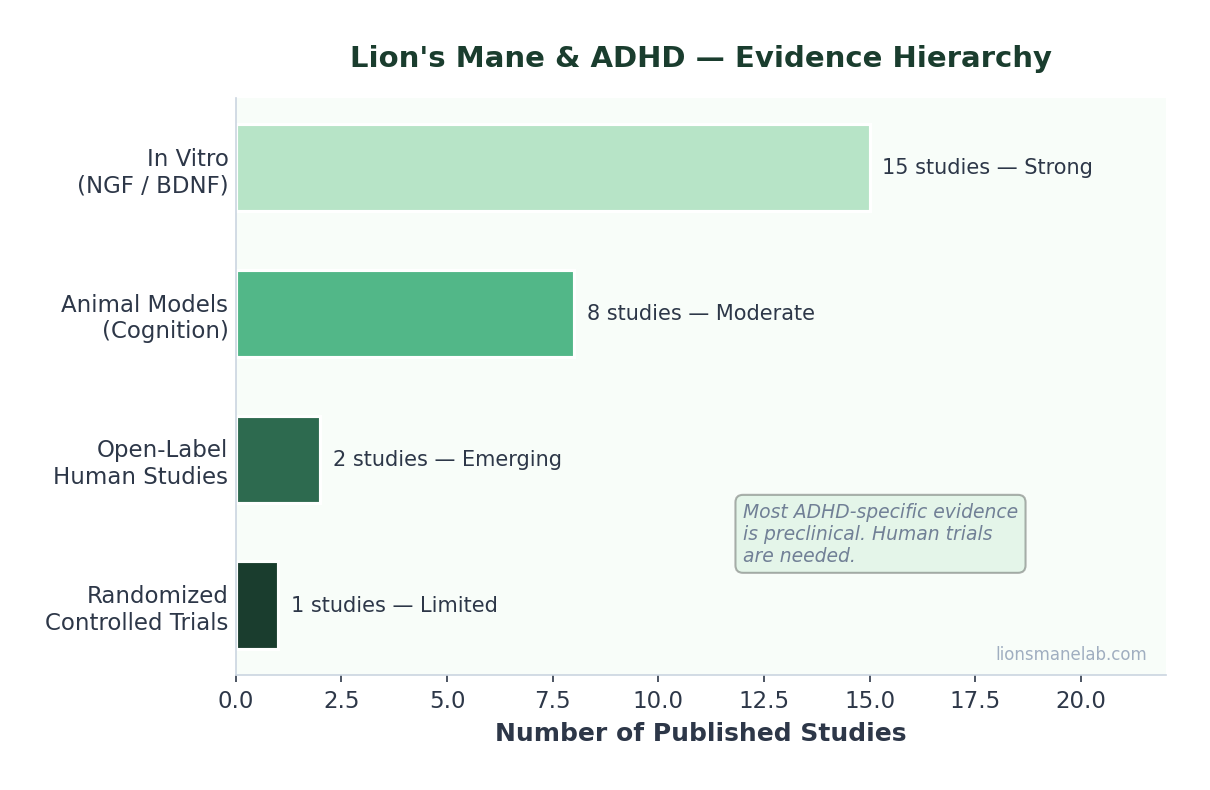
Animal and cell-culture studies provide stronger mechanistic support. Research has demonstrated that lion’s mane compounds may promote hippocampal neurogenesis in rodents, improve maze-learning performance, and reduce markers of neuronal damage under oxidative stress. These findings suggest potential benefits for memory consolidation and neural repair — cognitive domains that may overlap with some aspects of ADHD, particularly inattention and working memory.
The Critical Gap
No clinical trial has specifically evaluated lion’s mane for ADHD in humans — in adults or children. The preclinical data is interesting and the mechanistic rationale is plausible, but extrapolating from rodent neurogenesis studies to ADHD symptom management in people requires several leaps that the current evidence does not support. Anyone claiming lion’s mane is “proven” to help with ADHD is outpacing the science.
How Might Lion’s Mane Support Focus and Attention?
Get Our Free Mushroom Supplement Guide
Lab-tested brands, dosage protocols, and quality markers — delivered free.
No spam. Unsubscribe anytime.
While the direct evidence for lion’s mane and ADHD is absent, researchers have identified several theoretical mechanisms through which lion’s mane could potentially support aspects of cognitive function relevant to attention. These should be understood as hypotheses, not established effects.
NGF and Neural Connectivity
ADHD is associated with differences in neural connectivity, particularly in prefrontal cortex circuits responsible for executive function, impulse control, and sustained attention. NGF supports the growth and maintenance of these neural networks. The theory is that by promoting NGF production, lion’s mane might support healthier neural communication in these circuits. This has not been demonstrated in ADHD populations.
Anti-Inflammatory Pathways
A growing body of research has identified associations between neuroinflammation and ADHD symptoms in some individuals. Lion’s mane contains beta-glucans — polysaccharides with documented immune-modulating and anti-inflammatory properties. If chronic low-grade inflammation contributes to cognitive difficulties in some people with ADHD, lion’s mane’s anti-inflammatory compounds could theoretically offer support. This reasoning is biologically plausible but has not been validated in clinical settings specific to ADHD.
Gut-Brain Axis
Emerging research suggests that gut microbiome composition may influence neurotransmitter production and, potentially, attention and behavior. The enteric nervous system contains millions of NGF-responsive neurons, and lion’s mane has demonstrated prebiotic-like properties in some studies. The gut-brain axis connection to ADHD is an active area of investigation in neuroscience, but lion’s mane’s specific role in this pathway remains speculative.
What Lion’s Mane Cannot Do
Given the sensitivity of this topic — especially for parents researching options for their children — it is important to be explicit about the boundaries of what lion’s mane can and cannot offer.
- It is not a substitute for prescribed ADHD medication. Stimulant and non-stimulant medications prescribed for ADHD work through well-characterized mechanisms — primarily modulating dopamine and norepinephrine activity. Lion’s mane does not work through these pathways. If your healthcare provider has prescribed medication, do not stop, reduce, or modify it based on information about any supplement.
- It does not work like stimulant medications. There is no evidence that lion’s mane produces the acute improvements in focus and impulse control associated with medications like methylphenidate or amphetamine-based treatments. Lion’s mane is not a stimulant.
- Individual results vary enormously. Some people report subjective improvements in mental clarity; many others notice nothing. Biological individuality, ADHD symptom severity, sleep quality, diet, and overall health all influence outcomes.
- The evidence base is not ADHD-specific. All current claims connecting lion’s mane to ADHD are extrapolated from general cognitive research. This is not the same as evidence that it helps with ADHD.
For parents: please consult your child’s pediatrician or psychiatrist before introducing any supplement. Children’s brains are developing rapidly, and professional guidance is essential when considering anything that may influence neurological function.
Practical Considerations
If you have discussed lion’s mane with your healthcare provider and they are comfortable with you trying it as a complementary addition to your existing approach, here are practical factors to consider.
Dosage
Most cognitive studies in adults have used between 500mg and 3,000mg per day of concentrated lion’s mane extract. No ADHD-specific dosage exists because no ADHD-specific trials have been conducted. Starting at a lower dose (500mg) and gradually increasing allows you to assess tolerance. For detailed guidance, see our lion’s mane dosage guide.
For children, dosage guidance is even less established. Do not supplement a child without direct guidance from their healthcare provider.
Timeline
Lion’s mane is not an acute-effect compound. Available research suggests a minimum of 2 to 4 weeks of consistent daily use before any potential cognitive effects might become noticeable. The Mori 2009 study measured outcomes at 8 and 16 weeks. If you feel nothing after a few days, that is expected — the mechanism involves gradual NGF stimulation, not immediate neurotransmitter modulation. For more on what to expect, see our article on how long lion’s mane takes to work.
Quality Markers
Not all lion’s mane products are equivalent. If you decide to try supplementation, prioritize these quality indicators:
- 100% fruiting body extract or clearly labeled dual-extract containing both hericenones and erinacines
- Beta-glucan content above 25% — a reliable marker of proper extraction
- Third-party tested with Certificates of Analysis (COA) available
- No proprietary blends — you should see exactly how much lion’s mane is in each serving
- cGMP certified manufacturing facility
Real Mushrooms offers a 100% fruiting body extract with verified beta-glucan content and transparent third-party testing — meeting all of these criteria. View the Real Mushrooms lion’s mane extract here.
Safety
Lion’s mane is generally recognized as safe (GRAS). Side effects in clinical studies have been mild and uncommon — primarily digestive discomfort in the first few days. Allergic reactions are rare but possible, particularly for individuals with mushroom sensitivities. People taking blood thinners or immunosuppressants should consult their healthcare provider before supplementing, as interactions are possible. For a complete overview, see our article on lion’s mane side effects.
Stacking Considerations
Some individuals in the nootropic community combine lion’s mane with other supplements that have their own preliminary research related to focus and cognitive performance. Common pairings include:
- Alpha-GPC — a choline source that supports acetylcholine production, which plays a role in attention and learning. Some users combine it with lion’s mane on the theory that NGF support and acetylcholine availability work through complementary pathways.
- Bacopa Monnieri — an herb with some clinical evidence for memory consolidation. Like lion’s mane, it requires weeks of consistent use before potential effects emerge.
- Rhodiola Rosea — an adaptogen with preliminary research suggesting it may help with cognitive fatigue and mental stamina under stress.
Formal research on specific supplement combinations for ADHD-related symptoms is extremely limited. Always discuss any supplement stack with your healthcare provider, especially if you take prescription ADHD medication. Drug-supplement interactions are possible and not always well-documented. Our functional mushroom stack guide covers compatible pairings and safety considerations.
Bottom Line
The interest in lion’s mane and ADHD is understandable. People living with ADHD — and parents navigating options for their children — are often searching for approaches that complement established treatments. Lion’s mane, with its unique NGF-stimulating compounds and favorable safety profile, has become part of that conversation.
But intellectual honesty requires acknowledging where the evidence stands: there are no clinical trials specifically studying lion’s mane for ADHD. The existing research is preliminary, conducted primarily in animal models and small human studies focused on general cognitive impairment — not ADHD. The theoretical mechanisms are plausible but unvalidated for this particular condition.
What lion’s mane may represent is a supplement worth discussing with your healthcare provider as a potential complement to an existing ADHD management plan — not a replacement for evidence-based treatments. If you decide to try it, choose a quality extract, be consistent, allow adequate time, and keep expectations grounded in what the science actually shows.
For a broader overview of what this mushroom can offer, visit our guide to lion’s mane mushroom benefits. And above all, keep your healthcare provider involved in every decision about managing ADHD — whether conventional, complementary, or both.
References
- NIH National Institute of Mental Health: Attention-Deficit/Hyperactivity Disorder (ADHD)
- Lion’s Mane — Examine.com Evidence-Based Research Summary