
Lion’s Mane Before Bed: Should You Take It at Night?
One of the most common questions among new lion’s mane users is deceptively simple: when should I take it? Specifically, many people want to know whether taking lion’s mane before bed is a good idea — or whether it might interfere with sleep.
In This Article
- Lion’s Mane Before Bed: Should You Take It at Night?
- Does It Matter When You Take Lion’s Mane?
- Arguments for Taking Lion’s Mane Before Bed
- NGF and Sleep-Related Brain Processes
- User Reports of Improved Sleep Quality
- No Stimulant Compounds
- Anti-Anxiety Properties May Aid Relaxation
- Arguments for Taking Lion’s Mane in the Morning
- Mental Clarity and Focus During the Day
- Routine and Compliance
- Stacking with Morning Supplements
- Can Lion’s Mane Affect Sleep?
- Optimal Timing Strategies
- Split Dose: Half Morning, Half Evening
- Full Dose in the Morning
- Full Dose in the Evening
- What About Stacking with Sleep Supplements?
- Dosage Reminders
- Bottom Line
- References
Most supplements come with timing advice. Caffeine in the morning, magnesium at night, probiotics on an empty stomach. Lion’s mane (Hericium erinaceus) does not fit neatly into any of those categories, which leaves people guessing.
Here is what the available evidence, practitioner guidance, and user experience suggest about taking lion’s mane before bed — and why the answer may be more flexible than you expect.
Does It Matter When You Take Lion’s Mane?
The honest answer: there is no definitive clinical guidance on timing. No large-scale human trial has compared morning versus evening dosing and measured outcomes. The existing research on lion’s mane — which remains limited — has focused on whether the compound works, not on optimizing when it is taken.
That said, some functional mushroom practitioners suggest that timing may matter depending on your goals. Someone taking lion’s mane primarily for focus might prefer a morning dose, while someone interested in mood support might lean toward evening. These recommendations are based on user experience patterns, not controlled studies.
One thing that is well established: lion’s mane is not a stimulant. It does not contain caffeine or any compound known to activate the sympathetic nervous system. Its active compounds — hericenones and erinacines — work through nerve growth factor (NGF) stimulation, a slow-building biological process that unfolds over days and weeks, not minutes. For a full breakdown of these compounds, see our guide on lion’s mane mushroom benefits.
This means taking lion’s mane at night carries none of the risks associated with stimulant supplements. There is no pharmacological reason to avoid an evening dose.
Arguments for Taking Lion’s Mane Before Bed
Get Our Free Mushroom Supplement Guide
Lab-tested brands, dosage protocols, and quality markers — delivered free.
No spam. Unsubscribe anytime.
Several reasonable arguments support the case for nighttime dosing.
NGF and Sleep-Related Brain Processes
Lion’s mane’s primary mechanism involves stimulating NGF production — supporting the growth, maintenance, and survival of neurons. Research suggests that many neuroplastic processes, including memory consolidation and synaptic pruning, are especially active during sleep.
The reasoning some practitioners offer: if lion’s mane supports NGF production, and NGF-dependent processes are amplified during sleep, then taking lion’s mane before bed may allow these pathways to work in concert with the brain’s natural overnight repair cycle. This is a plausible hypothesis, but it has not been tested in a controlled study. It remains a logical framework, not a proven strategy.
User Reports of Improved Sleep Quality
Some users report that taking lion’s mane in the evening appears to support their sleep quality — falling asleep more easily, experiencing deeper rest, or waking up more refreshed. These are anecdotal observations that have not been validated in sleep studies using objective measures. Individual experiences vary significantly, and placebo effects are always possible with subjective sleep assessments.
No Stimulant Compounds
This point bears repeating: lion’s mane does not contain caffeine or any stimulant compound. There is no ingredient that should keep you awake. This puts it in a fundamentally different category from supplements that genuinely interfere with sleep when taken at night.
Anti-Anxiety Properties May Aid Relaxation
Some preclinical research suggests lion’s mane may have anxiolytic-like properties. A small number of limited human studies have shown reduced self-reported anxiety in participants taking lion’s mane, though these involved small sample sizes. If lion’s mane does support a calmer mental state for some individuals, this effect could theoretically aid the transition into sleep. For a deeper look at this evidence, see our article on lion’s mane and anxiety.
Arguments for Taking Lion’s Mane in the Morning
The case for morning dosing is equally reasonable, though it rests on different priorities.
Mental Clarity and Focus During the Day
Some users report that lion’s mane supports sharper focus and reduced brain fog, and they prefer to take it when they need that support most — during the workday. While lion’s mane does not produce acute alertness, the subtle cognitive benefits some users notice may feel most relevant during periods of concentrated mental effort.
Routine and Compliance
The most underrated argument for morning dosing is practical: it is easier to remember. Pairing lion’s mane with breakfast creates a reliable daily cue. A dose you actually take every day will outperform a theoretically optimal dose you forget three times a week. For guidance on building a consistent routine, see our guide on how to take lion’s mane.
Stacking with Morning Supplements
Many people who take lion’s mane also take other morning supplements — coffee, Alpha-GPC, or a mushroom coffee blend. Taking everything at once simplifies the routine and reduces missed doses.
Can Lion’s Mane Affect Sleep?
This is where many people get stuck, so let’s address the concern directly.
Lion’s mane is not a sedative. It does not cause drowsiness. If you are hoping it will knock you out like melatonin, it will not.
Lion’s mane does not appear to cause insomnia. There is no published evidence linking lion’s mane to sleep disruption. Some users on supplement forums report sleep disturbances, but these reports are inconsistent and have not been replicated in controlled settings.
Some users report vivid dreams. This is one of the more frequently mentioned anecdotal observations in lion’s mane communities. This has not been studied scientifically, and it is impossible to know whether lion’s mane is actually responsible or whether the association is coincidental. If vivid dreams are bothersome, some users report that switching to a morning dose resolves the issue.
Anti-anxiety effects may indirectly support sleep. For individuals whose sleep difficulty relates to racing thoughts or nighttime anxiety, lion’s mane’s potential anxiolytic properties could play an indirect supporting role. If a compound helps reduce mental tension, and mental tension is what keeps you awake, the result could be easier sleep onset. This pathway has not been studied directly.
For a comprehensive review of what to watch for, read our lion’s mane side effects guide.
Optimal Timing Strategies
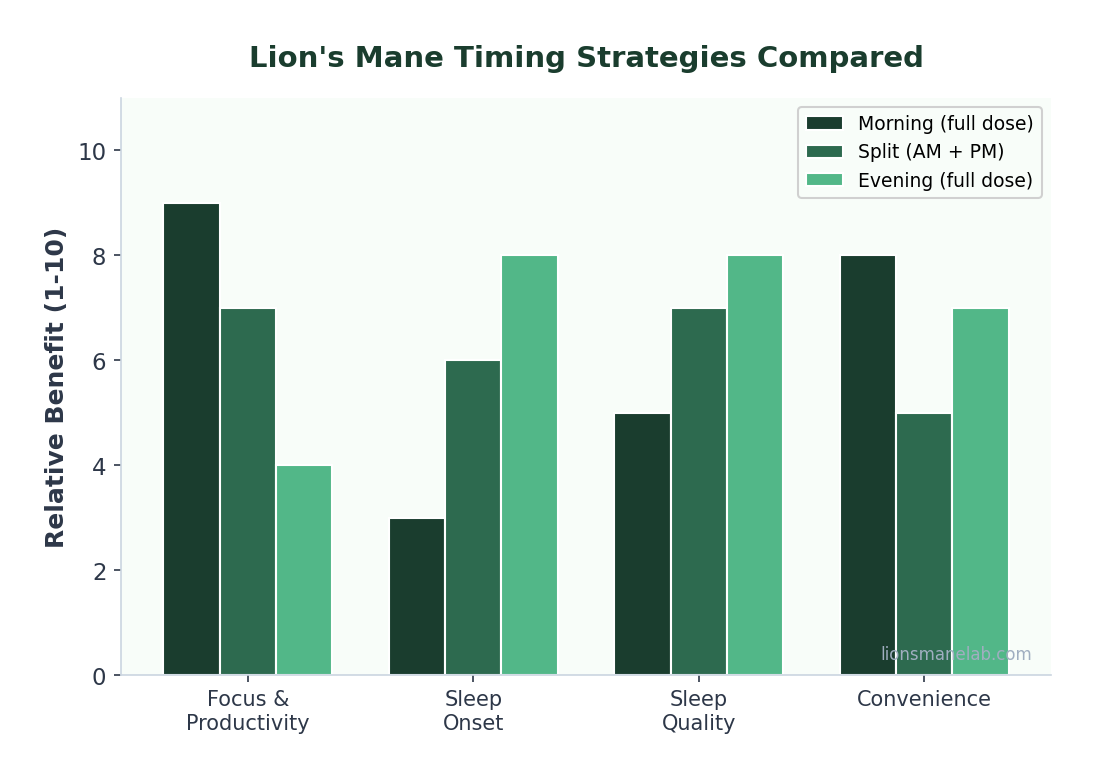
Given the lack of definitive research on timing, the best approach is to match your schedule to your goals. Here are three common strategies.
Split Dose: Half Morning, Half Evening
Taking half your daily dose with breakfast and the other half before bed provides more even distribution throughout the day. If your target is 1,000mg per day, that means 500mg morning and 500mg evening. This appeals to people who want to cover both daytime cognitive support and overnight neuroplastic processes.
Full Dose in the Morning
Best suited for people whose primary goal is daytime cognitive performance. This is also the simplest approach to maintain as part of a morning routine, especially if you are combining lion’s mane with coffee or other supplements.
Full Dose in the Evening
A reasonable choice for people focused on mood support and relaxation, or anyone who simply finds it easier to remember supplements at night.
The most important principle: consistency matters more than timing. The benefits of lion’s mane build cumulatively over weeks of daily use. Taking it at a “suboptimal” time every single day will produce far better results than taking it at the “perfect” time sporadically. Our article on how long lion’s mane takes to work covers the realistic timeline in detail.
What About Stacking with Sleep Supplements?
If sleep quality is your primary concern, lion’s mane is not the functional mushroom most commonly recommended for that goal. That distinction belongs to reishi (Ganoderma lucidum).
Reishi has a longer history of use as a calming agent in traditional Chinese medicine, and some preliminary research suggests it may support sleep quality through its triterpene content. If sleep is a priority, a reishi and lion’s mane evening stack is a combination some practitioners recommend — reishi for its potential calming properties, lion’s mane for NGF-stimulating benefits during overnight brain processes. For more on reishi, see our guide on reishi mushroom benefits.
A few practical notes on evening stacking:
- Avoid combining with stimulants at night. No mushroom coffee blends (which contain caffeine) and no energizing supplements like cordyceps in the evening. Lion’s mane itself is fine — it is the other ingredients in some combination products that can cause issues.
- Quality still matters. Choose a product made from 100% fruiting body with verified beta-glucan content and third-party testing. Real Mushrooms offers a well-tested lion’s mane extract that meets these criteria (view product).
- Consult your healthcare provider before combining lion’s mane with prescription sleep medications. Interactions are not well studied.
Dosage Reminders
The fundamentals of lion’s mane dosing remain the same regardless of when you take it.
- Typical daily range: 500mg to 3,000mg per day, depending on extract concentration and individual response.
- Start low: Begin with 500mg to 1,000mg per day to assess tolerance. Some people experience mild digestive discomfort when starting, which typically resolves by taking lion’s mane with food.
- Build gradually: If you tolerate the initial dose well after one to two weeks, increase to 1,000mg to 2,000mg per day.
- Give it time: Most users in available studies report noticeable effects after two to four weeks of consistent daily use. Commit to at least 30 days before evaluating. For detailed guidance, see our lion’s mane dosage guide.
Bottom Line
Taking lion’s mane before bed is perfectly reasonable. It is not a stimulant, it does not contain caffeine, and there is no published evidence suggesting it disrupts sleep. Some users report that evening dosing supports their sleep quality, and the biological rationale — aligning NGF stimulation with overnight brain maintenance — is plausible, even if unproven.
Morning dosing is equally valid, particularly for those focused on daytime cognitive performance or those who find a morning routine easier to maintain. A split dose covering both morning and evening is another sensible approach.
The best time to take lion’s mane is the time you will actually take it every day. Consistency drives results. Pick a schedule that fits your routine, start with a modest dose, give it at least a month, and pay attention to how you respond. If sleep quality is a primary goal, consider pairing lion’s mane with reishi in an evening stack for complementary support.
As with any supplement, individual results vary. Consult your healthcare provider before adding lion’s mane to your routine — especially if you take prescription medications or have existing health conditions.
References
- Lion’s Mane — Examine.com Evidence-Based Research Summary
- WebMD: Hericium Erinaceus (Lion’s Mane) — Overview and Dosing