Lion’s mane mushroom coffee has become one of the fastest-growing categories in functional beverages, with Four Sigmatic leading the charge. The pitch is simple: swap your regular morning cup for one infused with lion’s mane extract, and you may get cognitive support alongside your caffeine. But here is the question most reviewers skip — does mushroom coffee actually deliver a meaningful dose, or is it more of a gateway product than a standalone solution?
In This Article
- What Is Lion’s Mane Coffee and How Does It Work?
- The Dose Question: What Mushroom Coffee Actually Delivers
- The Compliance Advantage: Why the Coffee Format Still Matters
- Who Should Use Mushroom Coffee (and Who Needs More)
- Mushroom Coffee Makes Sense If You:
- You Probably Need Dedicated Capsules If You:
- The Stacking Strategy for Serious Users
- Four Sigmatic: A Closer Look at the Leading Brand
- What to Look for When Choosing a Mushroom Coffee
- Frequently Asked Questions
- Does lion’s mane coffee actually work?
- How much lion’s mane is in Four Sigmatic coffee?
- Can I drink mushroom coffee every day?
- Is mushroom coffee better than lion’s mane capsules?
- Does mushroom coffee taste like mushrooms?
- The Bottom Line
- References
What Is Lion’s Mane Coffee and How Does It Work?
Lion’s mane coffee is exactly what it sounds like: ground coffee blended with powdered lion’s mane mushroom extract (Hericium erinaceus). The idea is to combine the alertness boost of caffeine with the potential cognitive support of lion’s mane’s bioactive compounds — primarily hericenones and erinacines, which research suggests may stimulate Nerve Growth Factor (NGF) synthesis in the brain.
Brands like Four Sigmatic have popularized this format by making functional mushrooms approachable. Rather than swallowing capsules or mixing earthy-tasting powder into a smoothie, you brew a cup of coffee that tastes like regular coffee.
Many mushroom coffee products go beyond lion’s mane alone. Four Sigmatic’s lineup often includes chaga (traditionally used for immune support), reishi (associated with stress management), and cordyceps (linked to energy and oxygen utilization). This multi-mushroom approach creates a broad-spectrum beverage, though it also means the dose of any single mushroom is further divided.
For a deeper look at the science behind these compounds and what they may do in the body, our full guide on lion’s mane mushroom benefits covers the research in detail.
The Dose Question: What Mushroom Coffee Actually Delivers
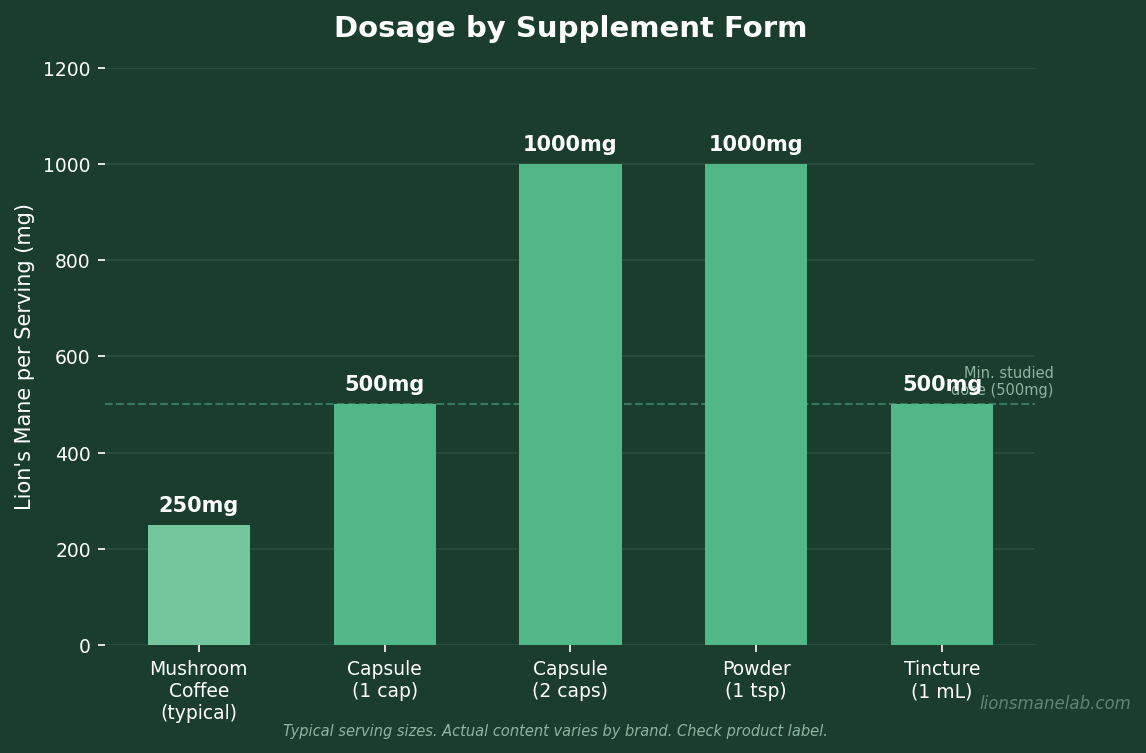
This is where an honest assessment becomes critical. Most lion’s mane research uses doses in the range of 500mg to 3,000mg of concentrated extract per day. A typical serving of mushroom coffee contains roughly 250mg to 500mg of lion’s mane extract. Some products specify this on the label; others bury it in a proprietary blend that makes the exact amount impossible to determine. When a product lists a “mushroom blend” of 500mg that includes lion’s mane, chaga, and cordyceps, the actual lion’s mane content may be a fraction of that total.
Here is what this means in practical terms:
- Single-mushroom coffee products that deliver 250-500mg of lion’s mane per serving sit at the low end of researched dosage ranges
- Multi-mushroom blends may deliver significantly less than 250mg of lion’s mane per serving, depending on the blend ratio
- Dedicated lion’s mane capsules from brands like Real Mushrooms typically deliver 500mg-1,000mg per capsule, making it easy to reach researched dose ranges
- Two cups per day of a quality mushroom coffee may bring you closer to meaningful territory, but you are also doubling your caffeine intake
None of this means mushroom coffee is useless. It means you should understand what you are getting and set expectations accordingly. For a complete breakdown of researched amounts, check our lion’s mane dosage guide.
The Compliance Advantage: Why the Coffee Format Still Matters
Get Our Free Mushroom Supplement Guide
Lab-tested brands, dosage protocols, and quality markers — delivered free.
No spam. Unsubscribe anytime.
Here is something the dose-focused critics often overlook: the best supplement is the one you actually take consistently. And this is where mushroom coffee genuinely shines.
Most people already drink coffee every morning — a built-in daily habit with zero willpower required. Swapping your regular coffee for a mushroom-infused version means you get some level of lion’s mane exposure without adding a single step to your routine. Compare that to capsule supplementation, where adherence data consistently shows a significant percentage of people stop taking capsules within the first few months.
This matters because available research suggests that lion’s mane benefits may build over time. Most users in available studies report noticeable effects after 2 to 4 weeks of consistent daily use, with individual variation being significant. A capsule regimen abandoned after two weeks may deliver less cumulative exposure than a lower-dose coffee consumed daily for six months.
There is also the taste factor. Lion’s mane powder on its own has an earthy flavor that many people find unpleasant. The coffee format masks this effectively, making the experience indistinguishable from a normal cup for most drinkers.
Who Should Use Mushroom Coffee (and Who Needs More)
Based on the dose realities and the compliance benefits, mushroom coffee fits into a few specific use cases better than others:
Mushroom Coffee Makes Sense If You:
- Already drink coffee daily and want to add potential cognitive support with zero extra effort
- Are new to functional mushrooms and want a low-commitment way to explore the category
- Prefer a gentler, lower-dose approach rather than aggressive supplementation
- Dislike swallowing capsules or mixing powders into drinks
- Want the combined benefits of multiple functional mushrooms in a single daily habit
You Probably Need Dedicated Capsules If You:
- Have specific cognitive goals like addressing persistent brain fog (see our guide on lion’s mane for brain fog)
- Want to reach the higher end of researched dosage ranges (1,000mg-3,000mg daily)
- Need to control the exact dose and source of your lion’s mane extract
- Care about whether your extract comes from fruiting body, mycelium, or a dual extract — a distinction we cover in depth in our fruiting body vs. mycelium comparison
The Stacking Strategy for Serious Users
For people who want both convenience and meaningful doses, the most practical approach is stacking: use mushroom coffee as your baseline daily exposure, then add a dedicated lion’s mane capsule to bring your total daily intake into the range that research has actually studied. This way, you get the compliance benefit of the coffee habit plus the dosing precision of capsules.
A typical stack might look like one cup of Four Sigmatic mushroom coffee in the morning (250-500mg lion’s mane plus other functional mushrooms) combined with a dedicated lion’s mane capsule providing an additional 500-1,000mg. This puts you squarely in the range that preclinical and early human research has explored. For more ideas on combining mushroom supplements effectively, see our functional mushroom stack guide.
Four Sigmatic: A Closer Look at the Leading Brand
Four Sigmatic essentially created the mainstream mushroom coffee category and remains the most widely available option.
What they do well:
- Product range: Multiple formats including instant packets, ground coffee, and K-cup pods
- Taste: Consistently rated among the best-tasting mushroom coffees, with mushroom flavor virtually undetectable
- Multi-mushroom formulas: Many products combine lion’s mane with chaga, reishi, or cordyceps
- Accessibility: Available on their website, Amazon, and many retail stores
- Third-party testing: Products undergo third-party lab testing
What to be aware of:
- Dose transparency: Not all products specify exact amounts of each mushroom per serving
- Blend type varies: Different products use different mushroom sourcing and processing — read labels carefully
- Price premium: Mushroom coffee costs significantly more per cup than conventional coffee
- Not a therapeutic dose: A single serving is unlikely to match the amounts used in most research studies
For people who decide mushroom coffee is the right entry point, Four Sigmatic is a solid starting place.
What to Look for When Choosing a Mushroom Coffee
Whether you choose Four Sigmatic or another brand, these quality markers separate a worthwhile product from a marketing exercise:
- Lion’s mane dose clearly stated: Avoid products that hide individual mushroom amounts inside a proprietary blend
- Extract vs. powder: Look for “lion’s mane extract” rather than just “lion’s mane powder” — extraction concentrates the bioactive compounds
- Fruiting body or dual extract preferred: Products specifying fruiting body extract or dual extract generally deliver a more complete compound profile. Our best lion’s mane supplement guide covers this in depth
- Beta-glucan content disclosed: Products that list beta-glucan percentages (look for 25% or higher) demonstrate confidence in extract quality
- Third-party testing: Certificates of analysis (COAs) available on request signal manufacturer transparency
- Coffee quality matters too: Look for organic or specialty-grade beans — some brands use low-quality coffee and lean entirely on the mushroom angle
Frequently Asked Questions
Does lion’s mane coffee actually work?
It depends on your definition. Mushroom coffee delivers caffeine-driven alertness with some level of lion’s mane exposure — that part works. Whether a single cup provides a research-level dose is a different question, and most products fall short of the 500mg-3,000mg daily range studied in available research. Mushroom coffee may support cognitive function as part of a broader routine, but individual results vary. For higher doses, consider stacking coffee with a dedicated lion’s mane supplement.
How much lion’s mane is in Four Sigmatic coffee?
The amount varies by product. Some Four Sigmatic products list a specific lion’s mane dose per serving (typically 250-500mg), while blended formulas combine multiple mushrooms into a single listed amount. Always check the supplement facts panel on the specific product rather than assuming all Four Sigmatic products deliver the same dose.
Can I drink mushroom coffee every day?
Lion’s mane is generally recognized as safe for daily use. The coffee component carries the same considerations as any daily coffee habit — caffeine sensitivity, sleep timing, and individual tolerance. If you are taking blood thinners or immunosuppressants, consult your healthcare provider before starting.
Is mushroom coffee better than lion’s mane capsules?
Neither format is categorically better — they serve different purposes. Capsules offer precise dosing and higher concentrations, making them more suitable for people targeting specific research-backed dose ranges. Mushroom coffee offers superior compliance for people who would otherwise forget or skip capsule supplementation. The most effective approach for serious users may be combining both: mushroom coffee for daily baseline exposure and capsules for dosing precision. Our complete breakdown is in the lion’s mane dosage guide.
Does mushroom coffee taste like mushrooms?
Quality mushroom coffee products like Four Sigmatic are formulated so that the mushroom extract does not significantly alter the taste. Most people report the flavor is indistinguishable from regular coffee or has only a very subtle earthy undertone. This is one of the primary advantages of the coffee format — it masks the earthy taste that many find off-putting when taking lion’s mane as a straight powder or tincture.
The Bottom Line
Lion’s mane mushroom coffee is a convenient, palatable way to introduce functional mushrooms into your daily routine. It is not, however, a high-dose lion’s mane supplement. The honest assessment is that most mushroom coffee products deliver doses at the lower end of — or below — what available research has studied for cognitive support benefits.
That does not make it worthless. The compliance advantage of building lion’s mane into a habit you already have is real and significant. For people exploring functional mushrooms for the first time, a product like Four Sigmatic offers a genuinely low-friction starting point with the added benefit of exposure to multiple functional mushrooms.
For those with specific cognitive goals or who want to reach researched dose ranges, the practical recommendation is to stack: use mushroom coffee as your daily foundation and add a quality lion’s mane capsule from a brand like Real Mushrooms to bring your total intake into more meaningful territory. This combination gives you the best of both worlds — daily habit compliance plus dosing precision.
Whatever approach you choose, consistency matters more than any single dose. Research suggests that lion’s mane benefits may build over weeks of regular use, so the format that keeps you consistent is the one that will serve you best. Individual results vary, and as with any supplement, consult your healthcare provider before making changes to your routine.
References
- Friedman M. “Chemistry, Nutrition, and Health-Promoting Properties of Hericium erinaceus (Lion’s Mane) Mushroom Fruiting Bodies and Mycelia and Their Bioactive Compounds.” Journal of Agricultural and Food Chemistry, 2015.
- Mori K, et al. “Nerve growth factor-inducing activity of Hericium erinaceus in 1321N1 human astrocytoma cells.” Biological & Pharmaceutical Bulletin, 2008.
- Healthline: Mushroom Coffee — Benefits, Side Effects, and More
- Lion’s Mane — Examine.com Evidence-Based Research Summary