Lion’s Mane and Depression: A Careful Look at What Research Does — and Does Not — Show
Depression is one of the most complex and serious health conditions a person can face. It affects an estimated 280 million people worldwide, disrupts relationships and careers, and in its most severe forms can be life-threatening. It is not a mood you snap out of, and it is not a problem with a single cause.
In This Article
- Lion’s Mane and Depression: A Careful Look at What Research Does — and Does Not — Show
- Why Are Researchers Interested in Lion’s Mane for Mood?
- The Neurotrophin Hypothesis of Depression
- Anti-Inflammatory Pathways
- What Does the Research Show?
- The Nagano 2010 Study
- Preclinical (Animal) Evidence
- Important Limitations of Current Evidence
- What Lion’s Mane Cannot Do
- Practical Considerations If You’re Interested
- A Note on Related Topics
- Bottom Line
- References
If you are exploring whether lion’s mane mushroom (Hericium erinaceus) could play any role in supporting mood, an essential statement must come first: if you are experiencing depression, please consult a qualified healthcare provider. Lion’s mane is not a treatment for depression, and this article is not medical advice.
If you’re experiencing a mental health crisis, contact the 988 Suicide & Crisis Lifeline (call or text 988).
With those boundaries established, let’s examine the current state of research — why some researchers are interested, what the limited evidence shows, and why extreme caution is warranted.
Why Are Researchers Interested in Lion’s Mane for Mood?
The interest does not come from clinical breakthroughs. It comes from biology — specifically, from a hypothesis about how depression may work at the molecular level.
The Neurotrophin Hypothesis of Depression
One prominent theory in depression research is the neurotrophin hypothesis. In simplified terms: neurotrophins are proteins that support neuron growth, survival, and connectivity. Two are especially relevant — Nerve Growth Factor (NGF) and Brain-Derived Neurotrophic Factor (BDNF). Some research has observed that people with depression tend to have lower levels of BDNF and reduced neuroplasticity in brain regions involved in mood regulation, particularly the hippocampus and prefrontal cortex.
This does not mean low neurotrophins cause depression. The relationship is associative, not definitively causal, and depression is far too complex to reduce to a single molecular pathway. However, the neurotrophin hypothesis has opened a line of inquiry: could compounds that support neurotrophin production also support mood?
Lion’s mane contains bioactive compounds called hericenones (found in the fruiting body) and erinacines (found in the mycelium) that have been shown in laboratory studies to stimulate NGF synthesis. Some preclinical research also suggests these compounds may influence BDNF levels. This is the biological rationale behind the research interest — not clinical proof, but a plausible mechanism worth investigating. For a deeper examination of this pathway, see our guide on lion’s mane and neurogenesis.
Anti-Inflammatory Pathways
A separate but related line of research explores the connection between neuroinflammation and depression. Some studies have found elevated levels of pro-inflammatory markers in individuals with depression, leading researchers to hypothesize that chronic, low-grade inflammation in the brain may contribute to depressive symptoms in some people.
Lion’s mane contains beta-glucans — polysaccharides with documented immune-modulating and anti-inflammatory properties. If neuroinflammation plays a role in depression for some individuals, the anti-inflammatory properties of lion’s mane compounds could theoretically be relevant. However, this chain of reasoning remains speculative. Each link — inflammation contributes to depression, lion’s mane modulates inflammation, therefore lion’s mane may support mood — requires further validation in controlled human studies.
What Does the Research Show?
Get Our Free Mushroom Supplement Guide
Lab-tested brands, dosage protocols, and quality markers — delivered free.
No spam. Unsubscribe anytime.
The honest answer: very little, and what exists comes with significant limitations. Let’s examine what is available.
The Nagano 2010 Study
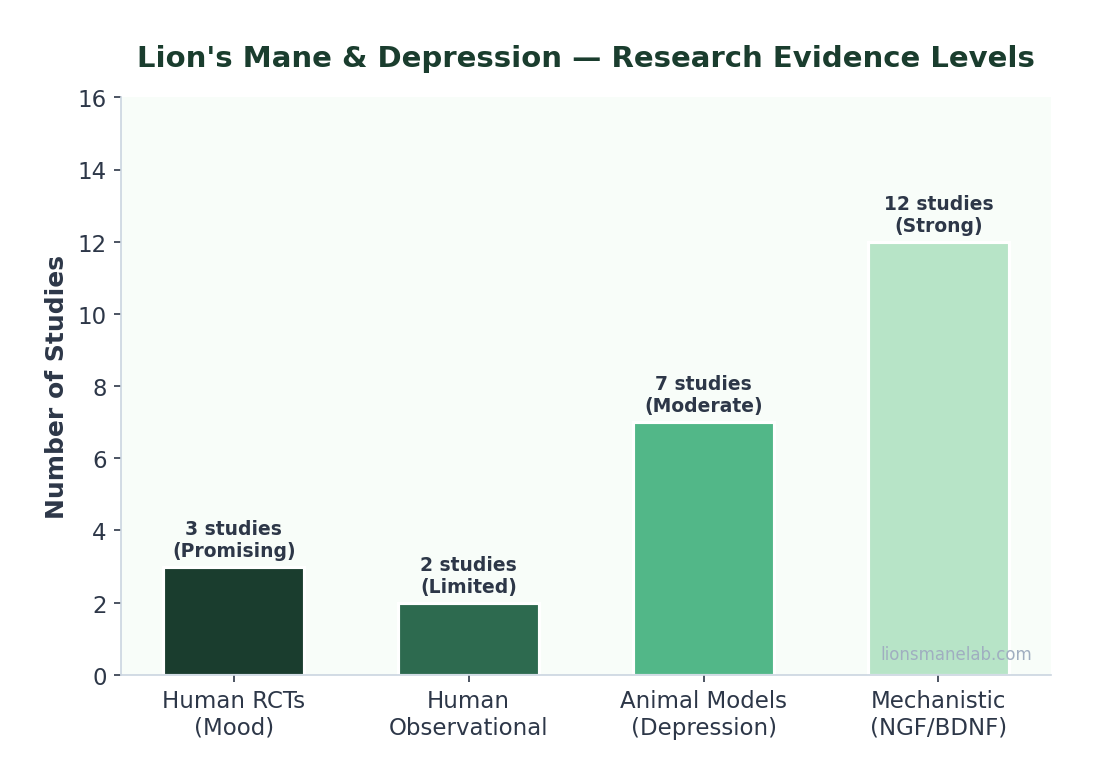
The most frequently cited study in discussions of lion’s mane and depression is Nagano et al. (2010). In this trial, 30 menopausal women consumed cookies containing lion’s mane or placebo cookies for four weeks. The lion’s mane group showed reduced scores on standardized measures of depression and anxiety compared to the placebo group.
This study provides a preliminary signal, but its limitations are substantial:
- Very small sample size — only 30 participants total
- Specific population — menopausal women, whose hormonal context differs significantly from the general population
- Short duration — only four weeks
- Delivery method — cookies, not a standardized extract
- Self-reported outcomes — based on questionnaire scores, not clinical diagnoses
- Depression was not the primary research question — it was measured alongside other mood indicators
This study does not demonstrate that lion’s mane reduces depression. It shows that in one very small group of menopausal women, self-reported mood scores improved over four weeks. That is a meaningfully different statement.
Preclinical (Animal) Evidence
Several animal studies have examined lion’s mane extracts in rodent models of depressive-like behavior. These studies have generally shown reduced depressive-like behaviors in mice and rats receiving lion’s mane, with researchers suggesting possible involvement of NGF and BDNF modulation pathways.
While these results contribute to our understanding of lion’s mane’s biological activity, animal models of depression are highly imperfect. A mouse swimming longer in a forced swim test is not the same as a human experiencing relief from clinical depression. The emotional, cognitive, and social dimensions of human depression cannot be replicated in rodent models. Preclinical evidence helps identify compounds worth studying further — it is not evidence that lion’s mane helps with depression in people.
Important Limitations of Current Evidence
Anyone evaluating lion’s mane for mood-related purposes should understand these critical limitations:
- No large-scale randomized controlled trials exist. The gold standard of clinical evidence — large, well-designed RCTs targeting depression as the primary outcome — has not been conducted for lion’s mane.
- Animal models do not reliably translate to humans. Many compounds that show promise in rodent models fail to demonstrate effects in human trials. The history of psychiatric drug development is filled with such examples.
- Depression is multifactorial. It involves genetics, neurotransmitter imbalances, hormonal factors, life circumstances, trauma, social isolation, and chronic stress. No single supplement can address all of these mechanisms.
- Lion’s mane has not been studied as a standalone depression intervention. No research has evaluated whether lion’s mane alone can meaningfully improve outcomes for people with diagnosed depressive disorders.
- Publication bias is a concern. Positive results are more likely to be published than negative ones, which can create a misleading picture of the evidence when the total number of studies is very small.
What Lion’s Mane Cannot Do
Given the seriousness of depression, it is essential to be explicit:
- Lion’s mane is not a replacement for professional mental health care. Therapy, counseling, and psychiatric care are evidence-based interventions for depression. A mushroom supplement is not comparable to these approaches and should never be used as a substitute.
- Lion’s mane is not comparable to studied antidepressant medications. SSRIs, SNRIs, and other antidepressant medications have been evaluated in thousands of clinical trials involving tens of thousands of patients. Lion’s mane has been examined in a handful of small studies. These are not in the same evidentiary category.
- Lion’s mane cannot address situational, social, or trauma-based depression factors. If depression stems from grief, relationship difficulties, financial stress, childhood trauma, or social isolation, no supplement addresses those root causes. Professional support and evidence-based therapy are the appropriate responses.
- Lion’s mane should never delay someone from seeking professional help. One risk of overpromising about supplements is that people may try them instead of pursuing the care they need. If you are struggling with depression, please talk to a healthcare provider. Individual results vary significantly, and depression is too serious to manage with unproven approaches alone.
For context on what lion’s mane research does and does not support more broadly, see our overview of lion’s mane mushroom benefits.
Practical Considerations If You’re Interested
If, after understanding the limitations above, you remain interested in lion’s mane as a potential complementary element within a professionally guided wellness plan, here is a responsible framework.
Talk to your healthcare provider first. This is not boilerplate advice — it is essential. A healthcare provider can evaluate whether lion’s mane is appropriate given your specific situation, current medications, and treatment plan. Some supplements can interact with psychiatric medications.
Do not stop existing medications without medical guidance. If you are taking antidepressants or other psychiatric medications, do not reduce or discontinue them based on anything in this article. Abruptly stopping certain medications can cause serious withdrawal effects and a dangerous worsening of symptoms. Medication changes should only occur under your prescribing provider’s direct supervision.
If your healthcare provider is comfortable with you trying lion’s mane alongside your existing treatment plan, here are practical considerations based on available research:
- Dosage: Most human studies have used between 500mg and 3,000mg per day of lion’s mane. Starting at a lower dose and gradually increasing allows you to assess tolerance. Consult your healthcare provider about what dose is appropriate for you. For general guidance, see our lion’s mane dosage guide.
- Timeline: Based on limited evidence, a minimum of four weeks of consistent daily use is needed before any potential mood-related effects might be noticed. Some studies extend to eight weeks or longer. Maintain realistic expectations — many people may notice no mood-related changes at all. For more detail, see our article on how long lion’s mane takes to work.
- Quality: Select a 100% fruiting body extract with verified beta-glucan content above 25%, third-party testing, and a Certificate of Analysis. Grain-diluted mycelium products may contain insufficient active compounds. Real Mushrooms offers a well-tested extract that meets these criteria (view product).
- Keep your provider informed. Tell your healthcare provider you are taking lion’s mane, especially if you take any medications. Transparency with your care team is always the right approach.
A Note on Related Topics
Depression and anxiety frequently co-occur. If you are interested in what research says about lion’s mane and anxiety, we cover that topic with similar caution in our article on lion’s mane and anxiety. Some people experiencing depression also report cognitive symptoms like difficulty concentrating — our article on lion’s mane and brain fog examines the separate (and somewhat stronger) evidence around cognitive support.
Bottom Line
The research connecting lion’s mane to mood is in its earliest stages. A small number of preclinical studies suggest biologically plausible mechanisms through neurotrophin pathways and anti-inflammatory activity. One very small human study in menopausal women showed improved self-reported mood scores over four weeks. That is the entirety of the direct evidence.
This is not grounds for recommending lion’s mane as a mood intervention. Depression is a serious, multifactorial condition that requires professional care. Lion’s mane has not been demonstrated in rigorous human trials to improve depressive symptoms, and it should never replace therapy, medication, or other evidence-based approaches.
What lion’s mane may represent — for some individuals, in consultation with their healthcare provider — is a complementary supplement worth discussing as part of a broader, professionally managed wellness plan. The honest position is significant caution paired with acknowledgment that the early science is interesting enough to warrant further research.
If you are struggling with depression, please reach out for help. Your healthcare provider, a therapist, or a crisis helpline can provide the support you need.
If you’re experiencing a mental health crisis, contact the 988 Suicide & Crisis Lifeline (call or text 988).