
If you’ve been researching lion’s mane mushroom, you’ve probably noticed that dosage recommendations vary wildly depending on the source. One brand says 500mg, another says 3,000mg, and a third suggests \”two scoops\” without specifying how much that actually is. The confusion is understandable — and it stems from an important reality: there is no FDA-established recommended dose for lion’s mane, and no universal clinical standard has been set.
In This Article
- Dosage by Goal: General Wellness, Cognitive Focus, and Research Protocols
- General Wellness: 500mg Per Day
- Cognitive Focus: 1,000mg Per Day
- Research Protocols: 2,000–3,000mg Per Day
- Form Factor Matters: Capsules, Powders, Tinctures, and More
- Capsules
- Powder
- Tinctures (Dual-Extract Liquid)
- Coffee Blends
- Gummies
- When to Take Lion’s Mane: Timing and Frequency
- Morning or Early Afternoon
- With or Without Food
- Consistency Over Timing
- Can You Take Lion’s Mane at Night?
- Timeline: How Long Until You Notice Anything?
- Safety Considerations and Who Should Be Cautious
- Frequently Asked Questions
- Can you take too much lion’s mane?
- Should I take lion’s mane every day or cycle it?
- Does the extract ratio (like 10:1 or 8:1) affect how much I should take?
- Can I take lion’s mane with other supplements or nootropics?
- Is it better to take lion’s mane as powder or capsules?
- Finding Your Right Dose
- References
That doesn’t mean we’re flying blind, though. Between published research protocols, traditional use patterns, and the practical experience of thousands of users, we can piece together a reasonable framework for lion’s mane dosing. This guide breaks down how much to take based on your goals, which form factors matter, when to take it, and how long you should expect to wait before noticing anything. If you’re new to lion’s mane and want to understand the full range of potential benefits, start there first — then come back here for the practical details.
Dosage by Goal: General Wellness, Cognitive Focus, and Research Protocols
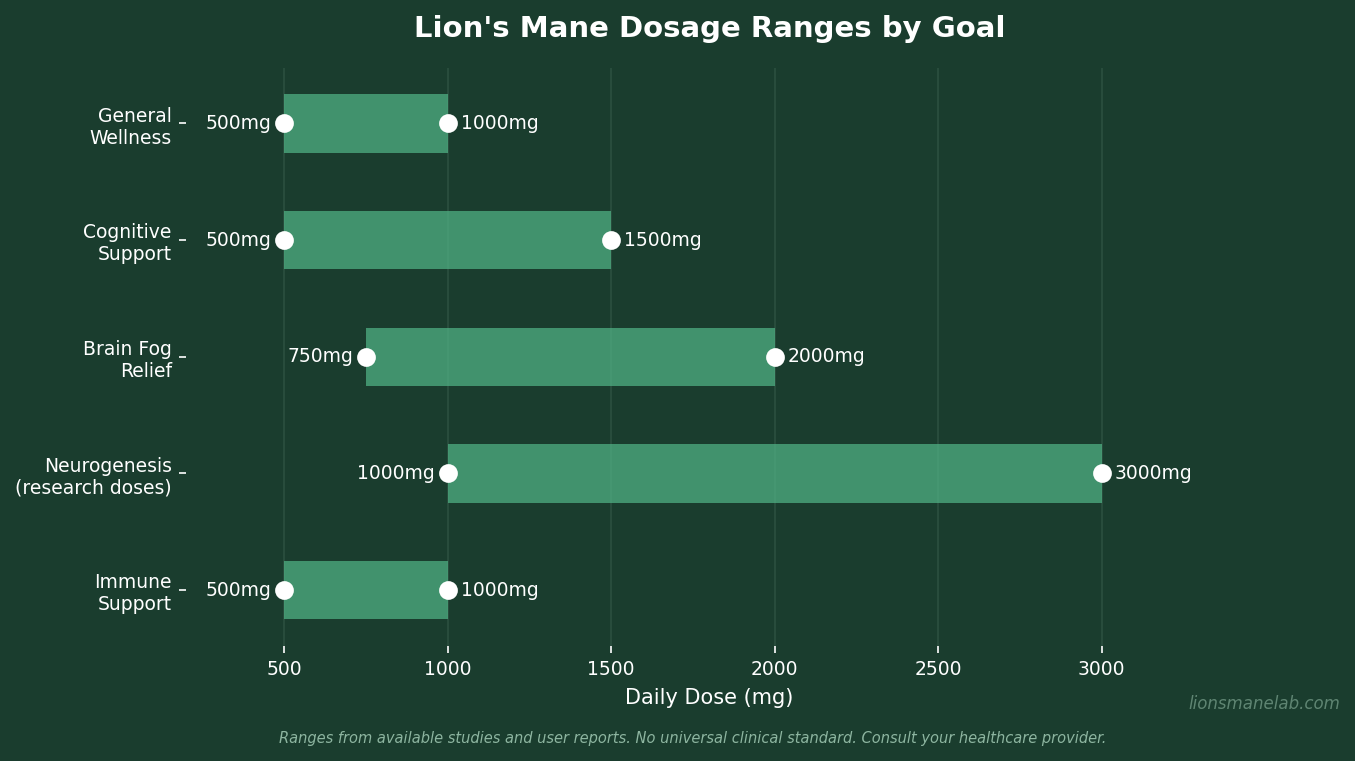
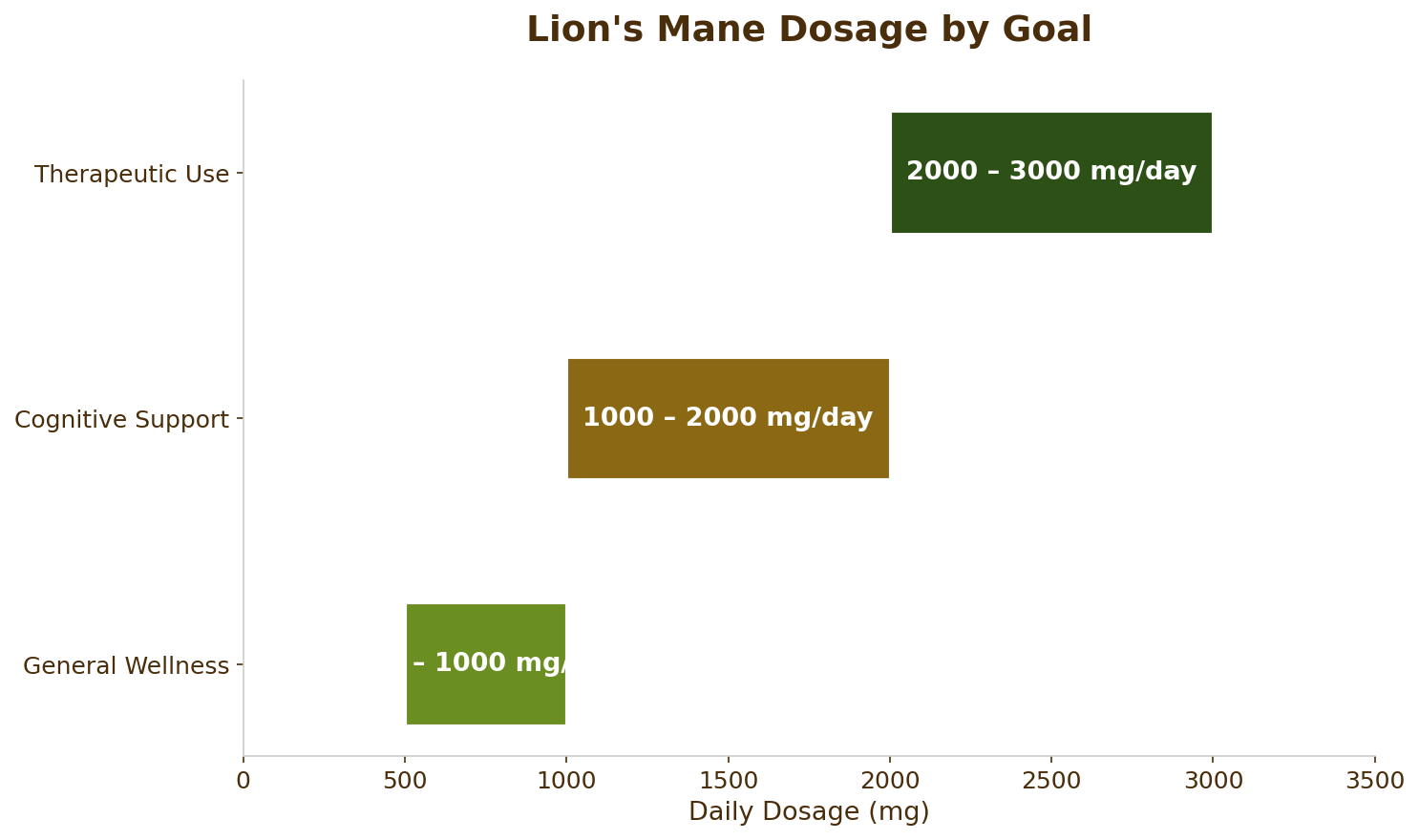
The most useful way to think about lion’s mane dosage is to match it to your intention. While individual responses vary and none of these tiers are carved in stone, the following ranges reflect what most reputable brands recommend and what the available research literature has used.
General Wellness: 500mg Per Day
If you’re taking lion’s mane as part of a broader supplement routine — not targeting any specific outcome, but simply including it for its potential long-term neuroprotective and immune-supporting properties — 500mg per day of a quality extract is a reasonable starting point. This is the dose many people begin with, and some stay here indefinitely.
At this level, you’re unlikely to notice dramatic short-term effects. The rationale is more about consistency over time. Some researchers have hypothesized that the hericenones and erinacines in lion’s mane may support nerve growth factor (NGF) production, and even modest daily intake could be meaningful over months and years. Think of it like a long-term investment rather than an immediate payoff.
Cognitive Focus: 1,000mg Per Day
This is the most popular dosage range among people who are specifically interested in lion’s mane for mental clarity, focus, and memory support. Research suggests that this mid-range dose may offer a better balance between efficacy and cost, and it aligns with what many supplement manufacturers recommend on their labels.
If you’ve been experiencing brain fog and want to see whether lion’s mane makes a difference, 1,000mg daily for at least four to eight weeks is a reasonable trial period. Some users split this into two 500mg doses — one in the morning and one in the early afternoon — though there is no strong evidence that splitting the dose is superior to taking it all at once.
Research Protocols: 2,000–3,000mg Per Day
Several published studies on lion’s mane in human subjects have used doses in the 2,000mg to 3,000mg per day range. For example, a well-known Japanese study on older adults with mild cognitive impairment used 3,000mg per day of lion’s mane dry powder (not a concentrated extract) over 16 weeks. Some studies indicate that higher doses in this range were associated with measurable improvements in cognitive test scores, though results were not universal across all participants.
It’s worth noting that study dosages often refer to the raw dried mushroom powder, not a concentrated extract. A 10:1 extract at 500mg could deliver a comparable amount of active compounds to 5,000mg of raw powder. This is one of the biggest sources of confusion in lion’s mane dosing — and why understanding extract ratios matters. We cover extract quality in more depth in our guide to choosing the best lion’s mane supplement.
- General wellness: 500mg/day of a quality extract
- Cognitive focus: 1,000mg/day, taken once or split into two doses
- Matching research protocols: 2,000–3,000mg/day (confirm whether studies used raw powder or concentrated extract)
If you’re unsure where to start, 500mg to 1,000mg per day is a sensible range for most people. You can always increase gradually after a few weeks if you want to explore higher doses.
Form Factor Matters: Capsules, Powders, Tinctures, and More
Lion’s mane comes in several forms, and the form you choose affects not just convenience but potentially how much of the active compounds you’re actually absorbing. Here’s a breakdown of the most common options.
Capsules
Capsules are the most straightforward option for precise dosing. Each capsule contains a measured amount — typically 500mg — so you know exactly how much you’re taking. They’re convenient, portable, and tasteless. The downside is that capsules sometimes contain fillers or flow agents, and you’re limited to the dose increments the manufacturer offers. For most people, capsules are the easiest way to maintain a consistent daily routine.
Powder
Loose powder gives you maximum flexibility over dosage. You can measure exactly the amount you want, and it mixes into smoothies, coffee, oatmeal, or just warm water. The trade-off is that you need a scale or a reliable measuring scoop, and the earthy, mildly seafood-like taste of lion’s mane powder isn’t everyone’s favorite. Powder also tends to be more economical per serving than capsules.
Tinctures (Dual-Extract Liquid)
Liquid tinctures — especially dual-extract versions that use both water and alcohol extraction — may offer superior bioavailability for certain compounds. Hericenones are alcohol-soluble while erinacines are water-soluble, so a dual-extraction process aims to capture a broader spectrum of active compounds. Dosage with tinctures is measured in droppers, and concentrations vary significantly between brands, so always check the label carefully.
Coffee Blends
Lion’s mane coffee blends have become popular for people who want to incorporate the mushroom into their existing morning routine. These typically contain a smaller amount of lion’s mane per serving — often 250mg to 500mg — combined with coffee or other functional ingredients. If you’re curious about this option, we’ve covered it in detail in our lion’s mane coffee guide. Just be aware that the dosage per cup may be lower than what you’d get from a standalone supplement.
Gummies
Gummies are the newest entrant to the lion’s mane market. They’re pleasant to take and easy to remember, but they often contain added sugars and may deliver lower doses of actual lion’s mane extract per serving. If taste and convenience are your top priorities and you’re aiming for a general wellness dose, gummies can work — but read the label carefully to see how much extract you’re actually getting per gummy versus how much is filler.
Regardless of form, prioritize products made from the fruiting body rather than mycelium on grain, as fruiting body extracts typically contain higher concentrations of the bioactive compounds that researchers are most interested in.
When to Take Lion’s Mane: Timing and Frequency
Get Our Free Mushroom Supplement Guide
Lab-tested brands, dosage protocols, and quality markers — delivered free.
No spam. Unsubscribe anytime.
One of the most common questions about lion’s mane is whether it matters when you take it. The honest answer is that we don’t have definitive research comparing morning versus evening dosing. However, practical experience and the nature of the supplement offer some guidance.
Related: Taking Lion’S Mane Before Bed
Morning or Early Afternoon
Most users and supplement brands recommend taking lion’s mane in the morning or early afternoon. The reasoning is straightforward: if you’re taking it for cognitive support, you want any potential effects to align with your working hours. Lion’s mane is not a stimulant — it doesn’t contain caffeine or anything that directly boosts alertness — but some users report feeling more mentally clear on the days they take it, and that clarity is more useful during waking hours.
With or Without Food
Lion’s mane is generally well-tolerated on an empty stomach, but some people experience mild digestive discomfort when taking supplements without food. If that’s you, take it with breakfast or lunch. There’s no strong evidence that food significantly impacts absorption, so go with whatever feels most comfortable and sustainable for your routine.
Consistency Over Timing
Ultimately, the most important factor isn’t whether you take lion’s mane at 7am or noon — it’s whether you take it consistently every day. The potential benefits of lion’s mane appear to be cumulative, building over weeks of regular use. Missing a day here or there probably doesn’t matter much, but sporadic use with long gaps is unlikely to give you meaningful results. Pick a time that works for your schedule and stick with it.
Can You Take Lion’s Mane at Night?
Some users actually prefer taking lion’s mane in the evening and report that it supports more restful sleep. While this is anecdotal and not well-studied, lion’s mane does not contain stimulants and is unlikely to interfere with sleep. If evening dosing fits your routine better, there’s no strong reason to avoid it. For a deeper dive into timing strategies, check out our complete guide on how to take lion’s mane.
Timeline: How Long Until You Notice Anything?
This is where managing expectations becomes critical. Lion’s mane is not a nootropic that you take in the morning and feel working by lunch. Its mechanisms of action — particularly the potential stimulation of nerve growth factor — are gradual biological processes, not instant chemical effects.
Based on user reports and the timelines used in research studies, here’s a realistic expectation framework:
- Week 1–2 (Building Phase): Most users report minimal to no noticeable change. This is normal. Your body is being introduced to the bioactive compounds, and any effects on NGF production or neural pathways take time to manifest. Don’t increase your dose out of impatience during this period.
- Week 2–3 (Early Signals): Some users begin to notice mild improvements in mental clarity, focus, or the ability to recall words more easily. These effects are subtle and easy to miss if you’re not paying attention. Keeping a simple daily journal can help you track whether anything is shifting.
- Week 3–4 (First Noticeable Effects): This is the window where most users who respond to lion’s mane report their first clear, noticeable effects. Common descriptions include \”less brain fog,\” \”thoughts feel sharper,\” and \”easier to stay focused for longer stretches.\” Individual results vary significantly.
- Week 4–8 (Continued Gradual Improvement): Users who are responding well tend to report continued, gradual improvement through the second month. Some research studies ran for 16 weeks, suggesting that benefits may continue to develop beyond the first month.
It’s important to note that not everyone responds to lion’s mane, and the strength of the response varies widely. Factors like the quality of the extract, your baseline cognitive function, sleep habits, stress levels, and genetics all play a role. If you’ve taken a quality product consistently for eight weeks and noticed nothing, lion’s mane may simply not be the right supplement for you — and that’s a valid outcome.
Safety Considerations and Who Should Be Cautious
Lion’s mane mushroom has a Generally Recognized as Safe (GRAS) status and has been consumed as food in East Asian cultures for centuries. For most healthy adults, it’s considered very well-tolerated. That said, a few important safety notes are worth highlighting.
Allergic reactions are rare but possible, particularly in people with known mushroom allergies. If you’ve ever had an allergic response to any type of mushroom, start with a very small dose and monitor your reaction, or consult with your healthcare provider before trying lion’s mane at all.
If you are currently taking blood-thinning medications (anticoagulants) or immunosuppressant drugs, you should consult your doctor before adding lion’s mane to your routine. Some research suggests lion’s mane may have mild antiplatelet activity and immune-modulating effects, which could theoretically interact with these medications. The risk is likely low, but it’s not worth taking chances with drug interactions.
Pregnant and breastfeeding women should also consult a healthcare provider before use, as there is insufficient research on lion’s mane safety in these populations.
For a more detailed look at potential side effects, our lion’s mane side effects guide covers everything from mild digestive issues to the rare allergic response.
Frequently Asked Questions
Can you take too much lion’s mane?
There is no established toxic dose for lion’s mane in humans, and it has a long history of use as a food in East Asia. That said, taking significantly more than 3,000mg per day of a concentrated extract is venturing beyond what most studies have tested, and there’s no evidence that extremely high doses provide additional benefits. Stick to the 500mg–3,000mg range and consult a healthcare provider if you want to experiment with doses above that. More is not always better with supplements.
Should I take lion’s mane every day or cycle it?
Most research protocols that showed positive results used daily dosing without cycling. The potential benefits of lion’s mane appear to be cumulative and depend on consistent intake. Some users choose to cycle — for example, five days on and two days off, or one month on and one week off — but there is no strong evidence that cycling is necessary or beneficial. If you respond well to daily use, there’s currently no research-based reason to take breaks, though some people prefer cycling as a general precaution with any supplement.
Does the extract ratio (like 10:1 or 8:1) affect how much I should take?
Yes, significantly. A 10:1 extract means that 10 pounds of raw mushroom material were concentrated into 1 pound of extract. In theory, 500mg of a 10:1 extract contains a similar amount of active compounds as 5,000mg of non-concentrated powder. When comparing dosages between products or against research studies, always check whether the source is referencing raw dried mushroom powder or a concentrated extract. This single factor accounts for most of the dosage confusion in the lion’s mane space. Our supplement comparison guide breaks down which brands offer what concentrations.
Can I take lion’s mane with other supplements or nootropics?
Lion’s mane is commonly stacked with other functional mushrooms like reishi and cordyceps, as well as nootropic compounds like bacopa monnieri and omega-3 fatty acids. There are no well-documented negative interactions between lion’s mane and other common supplements. However, the interaction between lion’s mane and prescription medications — particularly blood thinners and immunosuppressants — has not been extensively studied. If you take prescription medications, consult your healthcare provider before combining them with lion’s mane or any new supplement.
Is it better to take lion’s mane as powder or capsules?
From a dosing perspective, there’s no inherent advantage to either form as long as both products contain the same quality extract at the same concentration. Capsules offer convenience and precision. Powder offers flexibility and typically better value per gram. Some users prefer tinctures for potentially better absorption of certain compounds. The best form is the one you’ll actually take consistently. If measuring powder every morning sounds tedious to you, capsules will serve you better — because the dose you actually take is always superior to the dose sitting unused in your cabinet.
Finding Your Right Dose
The lack of a standardized lion’s mane dose can feel frustrating, but it also gives you the freedom to start conservatively and adjust based on your own experience. Begin with 500mg to 1,000mg daily of a quality fruiting body extract, maintain consistency for at least four weeks before evaluating results, and increase gradually if you want to explore higher doses up to the 2,000–3,000mg range used in research settings.
Keep in mind that dosage is only one piece of the puzzle. Extract quality, source material (fruiting body versus mycelium on grain), extraction method, and your own individual biology all influence outcomes. A lower dose of a high-quality extract may outperform a higher dose of a mediocre product.
If you’re ready to start but aren’t sure which product to choose, our best lion’s mane supplement guide ranks the top options based on extract quality, transparency, third-party testing, and value — so you can match the right product to whatever dose you decide to try.
References
- Mori K, et al. “Improving effects of the mushroom Yamabushitake (Hericium erinaceus) on mild cognitive impairment: a double-blind placebo-controlled clinical trial.” Phytotherapy Research, 2009.
- Nagano M, et al. “Reduction of depression and anxiety by 4 weeks Hericium erinaceus intake.” Biomedical Research, 2010.
- Lion’s Mane Dosage Information — Examine.com
- Memorial Sloan Kettering Cancer Center: Lion’s Mane Mushroom