What Is Lion’s Mane Extract vs. Raw Mushroom Powder?
Not all lion’s mane products are created equal. The distinction between a lion’s mane extract and raw mushroom powder determines whether a product delivers meaningful amounts of bioactive compounds or mostly inert fiber and starch.
In This Article
- What Is Lion’s Mane Extract vs. Raw Mushroom Powder?
- Types of Extraction: Hot Water, Alcohol, and Dual
- Hot Water Extraction
- Alcohol (Ethanol) Extraction
- Dual Extraction (Hot Water + Alcohol)
- Extract Ratios Explained: What “10:1” Actually Means
- Beta-Glucan Content: The Real Quality Marker
- Standardized Extract vs. Full-Spectrum Extract
- How to Read a Lion’s Mane Supplement Label
- Green Flags
- Red Flags
- Top Lion’s Mane Extract Options by Form
- Capsule Extracts
- Liquid Tinctures (Dual-Extract)
- Powder Extracts
- Price vs. Potency: Cost Per Active Compound Is What Matters
- Frequently Asked Questions
- Is lion’s mane extract safe to take daily?
- How long does it take to notice effects?
- What is the difference between lion’s mane extract and a tincture?
- Choosing the Right Lion’s Mane Extract
- References
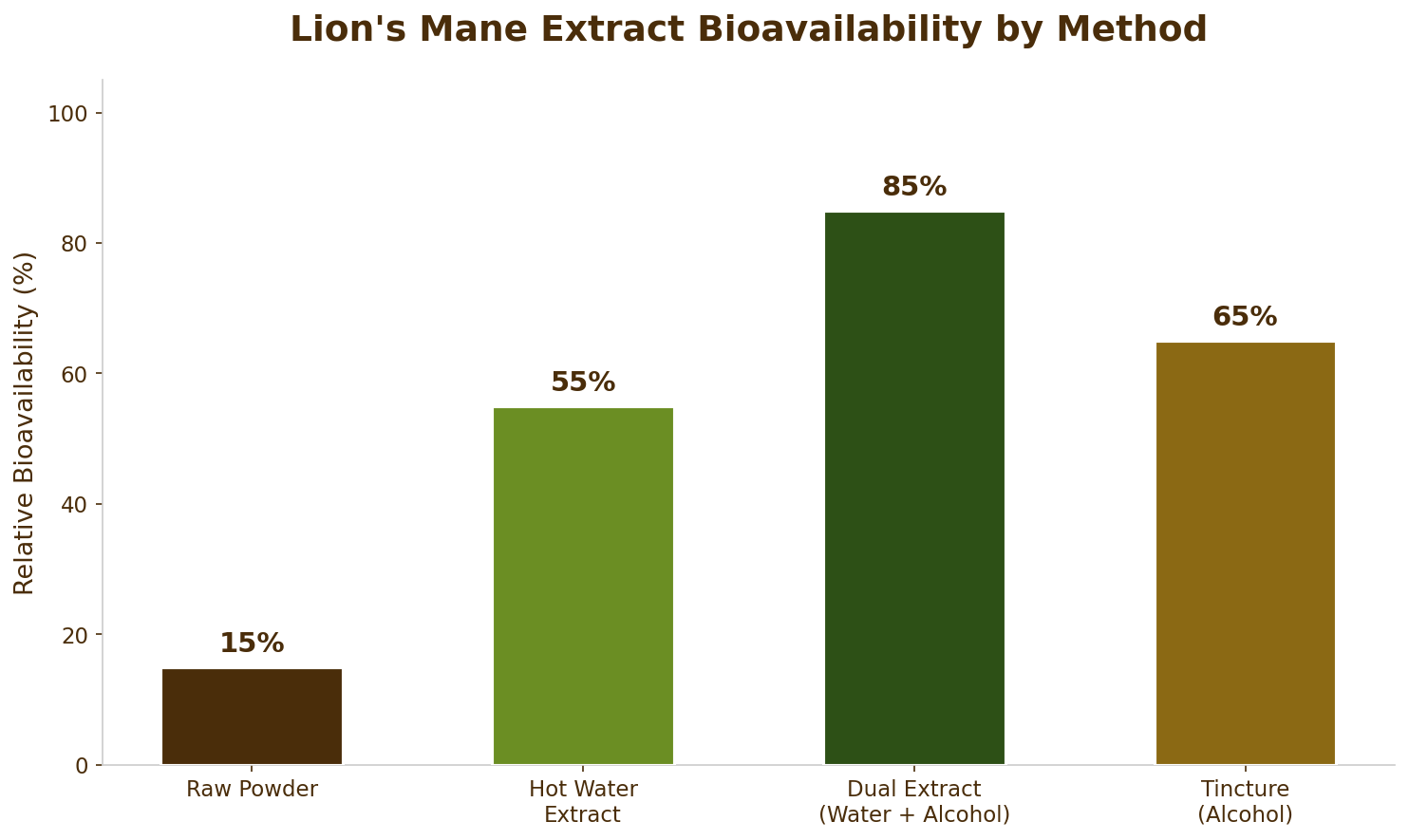
Raw lion’s mane powder is dried Hericium erinaceus ground into a fine powder. It retains the full matrix of the mushroom — fiber, chitin (tough fungal cell walls), and whatever bioactive compounds happen to be present. The problem is that key compounds like beta-glucans, hericenones, and polysaccharides are locked inside chitin-heavy cell walls that human digestion cannot efficiently break down.
A lion’s mane extract uses a solvent — hot water, alcohol, or both — to break open those cell walls and concentrate the target compounds into a more bioavailable form. The result is significantly higher active compound concentration per gram. This is why research on lion’s mane benefits almost exclusively uses extracted material rather than raw powder in study protocols.
Types of Extraction: Hot Water, Alcohol, and Dual
The solvent used determines which compounds end up in the final product, because different bioactive molecules dissolve in different media.

Hot Water Extraction
The oldest and most common method for medicinal mushrooms, hot water extraction pulls water-soluble compounds — primarily beta-glucans and other polysaccharides. These are the most widely studied and measurable active compounds in lion’s mane. Most reputable fruiting body extracts use this method, which has centuries of precedent in traditional Chinese and Japanese mushroom preparations.
Alcohol (Ethanol) Extraction
Alcohol extraction targets compounds that are not water-soluble, including hericenones — aromatic compounds that some studies indicate may stimulate Nerve Growth Factor (NGF) synthesis — along with terpenes and other secondary metabolites. Since hericenones are not water-soluble, a product made exclusively through hot water extraction may contain minimal amounts of these compounds.
Dual Extraction (Hot Water + Alcohol)
Dual extraction combines both methods to capture the maximum spectrum of bioactive compounds: beta-glucans from the water phase plus hericenones and terpenes from the ethanol phase. These products are most commonly sold as liquid tinctures. For anyone focused on cognitive support, dual extraction offers the broadest chemical profile since the hericenones pulled by alcohol extraction are central to the NGF research.
Extract Ratios Explained: What “10:1” Actually Means
Get Our Free Mushroom Supplement Guide
Lab-tested brands, dosage protocols, and quality markers — delivered free.
No spam. Unsubscribe anytime.
Ratios like “10:1 extract” describe the concentration factor: 10 kilograms of raw mushroom material produced 1 kilogram of extract. Higher ratios seem better at first glance, but the ratio alone tells you almost nothing about quality:
- The ratio does not specify which compounds were concentrated. A 20:1 extract could be concentrating beta-glucans or compounds with no known biological activity.
- Higher ratios can mean harsher extraction. Aggressive conditions may degrade heat-sensitive compounds.
- Starting material quality matters enormously. A 5:1 extract from high-quality organic fruiting body may outperform a 20:1 extract from low-quality mycelium grown on grain.
Extract ratios are a rough indicator of concentration but should never be the sole quality metric. Always look for what was measured in the final product — particularly beta-glucan percentage.
Beta-Glucan Content: The Real Quality Marker
If one number on a lion’s mane extract label matters more than any other, it is the beta-glucan percentage. For fruiting body extracts, greater than 25% beta-glucan content is the benchmark used by quality-focused brands and testing laboratories.
Why beta-glucans specifically?
- Measurable — standardized assays (like the Megazyme method) can quantify them precisely
- Researched — a substantial body of research suggests beta-glucans may support immune modulation
- A quality signal — high beta-glucan content correlates with proper extraction from genuine mushroom material, not grain filler
Some well-known brands — including Host Defense — do not publicly disclose beta-glucan content, making it impossible for consumers to verify potency. For a deeper look at how this affects product rankings, see our best lion’s mane supplement guide.
Standardized Extract vs. Full-Spectrum Extract
A standardized extract guarantees a specific concentration of target compounds — for example, “standardized to 30% beta-glucans.” This provides batch-to-batch consistency and makes comparison easy, though it may optimize for one compound class at the expense of others.
A full-spectrum extract aims to preserve the broadest range of compounds from the original mushroom. The rationale draws on the idea that compounds in a natural matrix may work synergistically. The limitation is that full-spectrum claims are harder to verify — without beta-glucan testing at minimum, “full-spectrum” can become a marketing term rather than a quality guarantee.
How to Read a Lion’s Mane Supplement Label
Label literacy is the most practical skill for navigating the lion’s mane market. Here is what to look for.
Green Flags
- “Extract” on the label — indicates an actual extraction process was used to concentrate compounds
- Stated beta-glucan percentage — a verifiable quality claim, especially when backed by third-party COA data
- Extraction method disclosed — “hot water extracted” or “dual extracted” shows transparency
- “Fruiting body” specified — distinguishes the product from mycelium-on-grain alternatives that may contain starch filler (see our fruiting body vs. mycelium comparison)
Red Flags
- “Mushroom powder” or “biomass” without “extract” — likely ground-up raw material with lower bioavailability
- No beta-glucan percentage stated — no way to verify potency
- “Mycelium biomass” or “mycelium on grain” — may contain significant grain starch that dilutes active compounds
- Proprietary blends — impossible to determine how much lion’s mane extract you are actually getting
Top Lion’s Mane Extract Options by Form
Capsule Extracts
Capsules provide a consistent, pre-measured dose with maximum convenience. Quality capsule extracts typically contain 500mg per capsule with a standard daily serving of two capsules (1,000mg). For a hot water extracted fruiting body capsule, Real Mushrooms uses 100% fruiting body with verified beta-glucan content above 25% and batch-specific third-party testing. Read our full assessment in the Real Mushrooms review.
Liquid Tinctures (Dual-Extract)
Tinctures are the primary format for dual-extract products. The liquid medium accommodates both water and alcohol extraction phases, delivering the broadest compound spectrum — beta-glucans plus hericenones and terpenes. They are typically taken sublingually or mixed into beverages. The trade-off is less precise dosing and a strong taste from the alcohol base.
Powder Extracts
Powder extracts offer the most flexibility — blend them into smoothies, stir into coffee, or mix into oatmeal. Om Mushrooms offers a well-regarded organic lion’s mane powder for daily use. Powders also make it easy to adjust your dose, which is useful when finding your optimal lion’s mane dosage.
Price vs. Potency: Cost Per Active Compound Is What Matters
Comparing lion’s mane products by price per gram or price per capsule is misleading. What actually determines value is the concentration of bioactive compounds in each serving.
Consider two products:
- Product A: 60 capsules for $15. Contains 500mg of mycelium biomass grown on rice, no extraction, no beta-glucan percentage disclosed. Starch testing might reveal 50%+ grain-derived alpha-glucans.
- Product B: 60 capsules for $30. Contains 500mg of hot water extracted fruiting body with verified beta-glucan content above 25% and third-party COA.
Product A costs half as much per capsule — but if a significant portion is grain starch, your cost per milligram of actual beta-glucans could be far higher than Product B. The useful metric is cost per active compound, not cost per gram.
When evaluating price, ask:
- Does the label state a beta-glucan percentage?
- Is it an extract or raw powder?
- Is it fruiting body or mycelium on grain?
- Is there third-party testing to verify claims?
Frequently Asked Questions
Is lion’s mane extract safe to take daily?
Lion’s mane is generally recognized as safe. Clinical studies have used 500mg to 3,000mg of concentrated extract daily over 8 to 16 weeks without significant adverse effects. Some individuals report mild digestive discomfort during the first few days. Consult your healthcare provider if you are pregnant, nursing, taking blood thinners, or on immunosuppressant medication. Individual results vary.
How long does it take to notice effects?
Research suggests lion’s mane works through cumulative mechanisms rather than producing same-day effects. Most studies and user reports indicate subtle cognitive effects may begin within two to four weeks of consistent daily use, with more noticeable results over six to eight weeks.
What is the difference between lion’s mane extract and a tincture?
A tincture is a type of extract — specifically, a liquid extract using alcohol as part of the process. Most tinctures are dual-extracts combining hot water and alcohol extraction. Capsule and powder extracts may use only hot water extraction. The best format depends on whether you prioritize convenience (capsules), compound spectrum (tinctures), or flexibility (powders). For practical guidance on administration, see our guide on how to take lion’s mane.
Choosing the Right Lion’s Mane Extract
The lion’s mane extract market rewards informed consumers. The gap between a well-extracted, transparently tested product and a grain-diluted powder with a mushroom label is enormous in terms of active compound content and real value.
Ignore the marketing and read the label. Look for the word “extract.” Look for a stated beta-glucan percentage above 25%. Look for extraction method disclosure. Look for third-party testing. These four data points will filter out the majority of low-quality products.
For product comparisons across these quality markers, see our best lion’s mane supplement ranking. For guidance on how much to take, our lion’s mane dosage guide covers research-backed ranges for different goals.
These statements have not been evaluated by the Food and Drug Administration. These products are not intended to diagnose, treat, cure, or prevent any disease.
Lion’s Mane Lab earns commissions from affiliate links at no extra cost to you.
References
- Spelman K, et al. “Neurological Activity of Lion’s Mane (Hericium erinaceus).” Journal of Restorative Medicine, 2017.
- Wu T, et al. “Comparison of bioactive compounds and bioactivities of mycelia and fruiting bodies of Hericium erinaceus.” Journal of Functional Foods, 2014.
- Lion’s Mane Extract Types — Examine.com Research Summary
- Memorial Sloan Kettering Cancer Center: Lion’s Mane Mushroom