The connection between your brain and your gut is not a metaphor. It is a physical, bidirectional communication network — and it is reshaping how researchers think about digestive wellness. Your gut contains over 500 million neurons, produces the majority of your body’s serotonin, and houses a microbiome so complex that scientists now refer to it as a separate organ. When mushroom researchers began investigating lion’s mane (Hericium erinaceus) for its effects on Nerve Growth Factor and cognitive function, an unexpected finding emerged: the same compounds that appeared to support brain health may also influence the gut. That dual relationship is why lion’s mane gut health has become one of the more interesting frontiers in functional mushroom research.
In This Article
- Lion’s Mane and the Gut-Brain Axis
- What Does Research Suggest About Lion’s Mane and Digestion?
- How Might Lion’s Mane Support Gut Health?
- Lion’s Mane and Digestive Discomfort — What to Know
- Best Forms for Gut Health
- Dosage and Timing for Digestive Support
- Other Mushrooms for Gut Health
- Bottom Line
- References
Lion’s Mane and the Gut-Brain Axis
The gut-brain axis is a communication network connecting your central nervous system to your enteric nervous system — the dense web of neurons embedded in the walls of your gastrointestinal tract. This connection operates through the vagus nerve, immune signaling pathways, and chemical messengers produced by gut bacteria. Signals travel in both directions: the brain influences gut motility and inflammation, while the gut sends information upstream that affects mood, cognition, and stress responses.
The enteric nervous system is not a simplified version of the brain. It is a sophisticated network that independently regulates digestion, coordinates muscular contractions, and modulates local immune responses. Researchers sometimes call it the “second brain.” Damage to enteric neurons, chronic inflammation in gut tissue, or disruption of the microbiome can send distress signals to the brain, potentially contributing to fatigue, cognitive sluggishness, and mood disturbances.
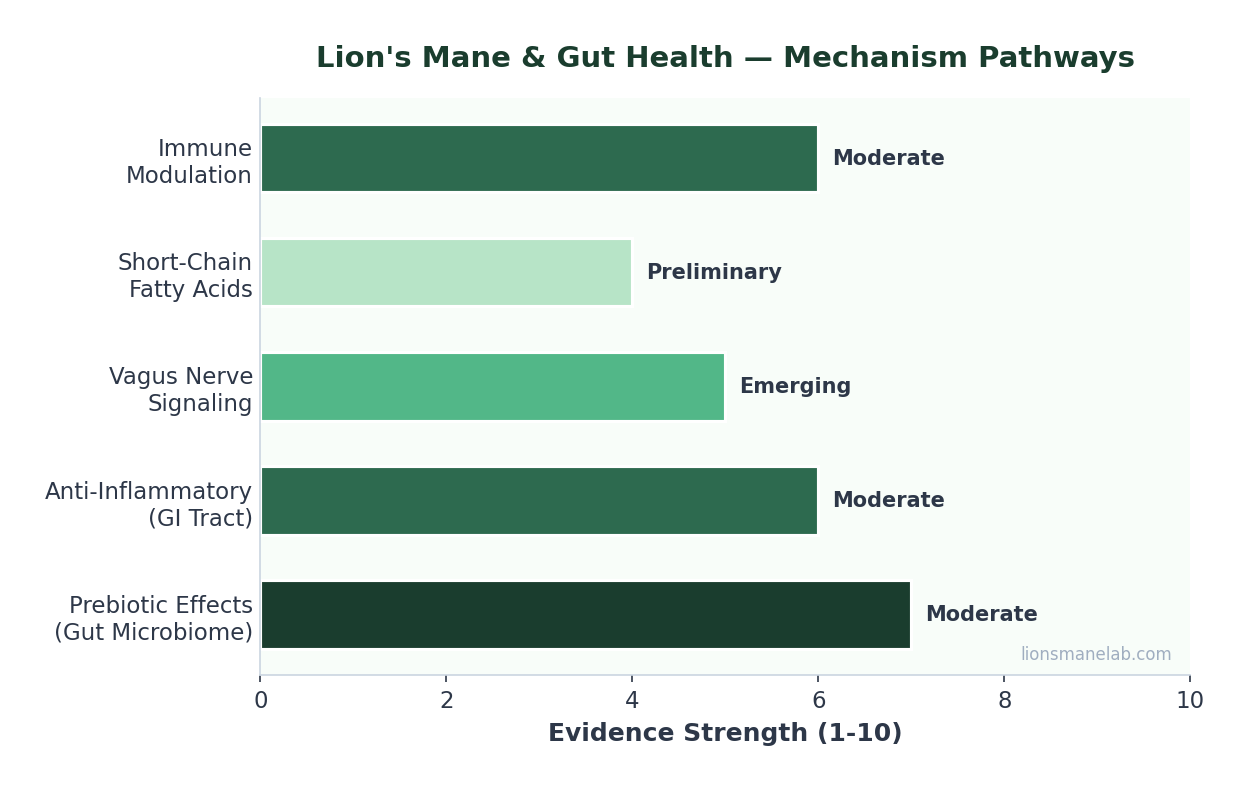
Among functional mushrooms, lion’s mane is uniquely positioned at this intersection. Its bioactive compounds operate through two complementary pathways: hericenones and erinacines stimulate Nerve Growth Factor (NGF), a protein critical for neuron growth and maintenance — including neurons in the gut. Simultaneously, lion’s mane contains prebiotic polysaccharides, primarily beta-glucans, that may feed beneficial gut bacteria and support microbiome diversity. For a deeper look at the NGF pathway, our guide to lion’s mane and neurogenesis covers the science in detail.
What Does Research Suggest About Lion’s Mane and Digestion?
Most research on lion’s mane and digestive health comes from animal models and in vitro (cell culture) studies. Human clinical trials focused specifically on gut outcomes are limited. The preclinical findings are meaningful, but they should be understood with that context.
Gastric mucosa protection. Several animal studies have investigated lion’s mane’s effects on the stomach’s protective lining. Research in rodent models suggests that lion’s mane polysaccharide extract may help support mucosal layer integrity, with proposed mechanisms involving antioxidant activity and modulation of inflammatory pathways. Translating these findings directly to human outcomes requires caution.
Anti-inflammatory compounds. Preclinical research suggests that certain compounds in lion’s mane — including polysaccharides and hericenones — may exhibit anti-inflammatory properties. In vitro studies have shown these compounds may reduce markers of inflammation in intestinal cell models. Some researchers hypothesize this could help support gut barrier integrity, though the mechanism has not been confirmed in human trials.
Beta-glucans as prebiotic fiber. Beta-glucans function as prebiotic fiber — indigestible compounds that serve as food for beneficial gut bacteria. Research suggests that mushroom-derived beta-glucans may support microbiome diversity by selectively feeding beneficial strains, including Bifidobacterium and Lactobacillus species. Some studies indicate lion’s mane polysaccharides may contribute to this effect, though species-specific human data remains limited.
The honest summary: preclinical evidence points to multiple plausible pathways through which lion’s mane may support digestive health. Promising does not mean proven.
How Might Lion’s Mane Support Gut Health?
Get Our Free Mushroom Supplement Guide
Lab-tested brands, dosage protocols, and quality markers — delivered free.
No spam. Unsubscribe anytime.
Drawing from the available research, several theoretical mechanisms emerge. These are biologically plausible and supported by preclinical data, but they should be understood as hypotheses rather than confirmed clinical outcomes.
Feeding beneficial bacteria. Lion’s mane polysaccharides resist digestion in the upper GI tract and reach the colon largely intact. There, beneficial bacteria ferment them into short-chain fatty acids (SCFAs), including butyrate — a primary energy source for colonocytes and a compound associated with healthy gut barrier function.
Modulating gut inflammation. Animal studies suggest lion’s mane extract may reduce pro-inflammatory cytokines in gut tissue. In rodent models of induced colitis, lion’s mane polysaccharide fractions appeared to attenuate inflammatory markers. However, animal models do not perfectly replicate human digestive conditions, and these results should not be interpreted as evidence that lion’s mane can address specific inflammatory conditions in humans.
NGF and the enteric nervous system. The enteric nervous system is rich in NGF-responsive neurons that regulate peristalsis and local immune responses. Some researchers have proposed that lion’s mane’s ability to stimulate NGF production may extend benefits to these gut neurons, potentially supporting healthier nerve-gut signaling. This theoretical mechanism connects lion’s mane’s well-documented NGF properties to digestive function — but direct evidence in human gut neurons is still lacking.
For a comprehensive overview of all researched benefits, see our complete guide to lion’s mane mushroom benefits.
Lion’s Mane and Digestive Discomfort — What to Know
Some users report mild gastrointestinal side effects when first starting lion’s mane. This may seem paradoxical for a supplement discussed for gut health, but the pattern is common with prebiotic-rich compounds.
The most commonly reported symptoms include:
- Mild gas or bloating — particularly in the first few days as the microbiome adjusts to new prebiotic substrates.
- Slight stomach discomfort — more common on an empty stomach or at higher initial doses.
- Changes in bowel habits — some users notice softer stools initially, which typically normalize within the first week.
These effects are generally temporary and dose-dependent, resolving within three to seven days. Start with a lower dose — around 250mg to 500mg daily — and increase gradually over one to two weeks.
Rare allergic reactions are possible, particularly in individuals with mushroom allergies. If you experience skin irritation, itching, or difficulty breathing, discontinue use and consult a healthcare provider immediately. Our detailed breakdown of lion’s mane side effects covers these scenarios in depth.
Best Forms for Gut Health
Powder may offer the most direct prebiotic benefit. Beta-glucan fiber reaches the gut readily available for fermentation by colonic bacteria, and powder allows flexible dosing during the adjustment period.
Capsules provide convenience and consistent dosing. The bioactive compounds are the same; the fiber accessibility may be slightly less compared to loose powder, but the difference is likely modest.
Dual-extract products (hot water plus alcohol extraction) capture both water-soluble compounds (beta-glucans, polysaccharides) and alcohol-soluble compounds (hericenones, certain terpenoids). For those interested in both prebiotic and NGF-supporting properties, dual extraction offers the broadest spectrum.
Regardless of format, quality matters most. Look for 100% fruiting body with verified beta-glucan content above 25%, third-party testing, and no filler ingredients. A product like Real Mushrooms Lion’s Mane (view product) meets these criteria with transparent COA testing — important when the prebiotic fiber fraction is part of why you are supplementing. For a full comparison, see our best lion’s mane supplement guide.
Dosage and Timing for Digestive Support
Most research places the effective range at 500mg to 2,000mg per day of concentrated extract. For digestive support specifically:
- Starting dose: 500mg per day for the first week, allowing the microbiome to adjust.
- Maintenance dose: 1,000mg to 2,000mg per day, based on individual tolerance.
- Timing: Taking lion’s mane with meals may reduce stomach sensitivity, as food buffers the digestive tract.
- Splitting doses: Dividing your daily dose between two meals can improve tolerance and provide more consistent prebiotic input.
Consistency matters more than any single dose. The prebiotic, anti-inflammatory, and potential NGF-related benefits all appear to be cumulative. Most practitioners suggest a minimum of four weeks of daily use before evaluating effects on digestive comfort. For a detailed dosing breakdown, see our lion’s mane dosage guide.
Other Mushrooms for Gut Health
Lion’s mane is not the only functional mushroom with connections to digestive wellness. Three other species deserve attention.
Turkey tail (Trametes versicolor) may be the strongest candidate for microbiome support. Its PSP and PSK compounds have demonstrated prebiotic activity in human studies, selectively promoting beneficial bacterial growth. Turkey tail’s beta-glucan content is among the highest of any medicinal mushroom. See our turkey tail mushroom benefits guide.
Reishi (Ganoderma lucidum) may support gut health through anti-inflammatory modulation and immune regulation within the GI tract. Its calming properties may also indirectly benefit digestion by reducing stress-related gut disturbances. Learn more in our reishi mushroom benefits guide.
Chaga (Inonotus obliquus) has the longest traditional history as a digestive aid, brewed as a tea in Siberian folk medicine for centuries. Its polysaccharides may support gut health through prebiotic mechanisms, while antioxidant compounds may help protect gut tissue from oxidative stress. See our chaga mushroom benefits overview.
Bottom Line
Lion’s mane occupies a genuinely unique position in the gut health conversation. No other functional mushroom offers the same combination of prebiotic polysaccharides, anti-inflammatory compounds, and NGF-stimulating activity — a trifecta that maps onto the three pillars of gut wellness: a diverse microbiome, a healthy gut lining, and a well-functioning enteric nervous system.
The caveats are real. Most evidence for lion’s mane gut health benefits comes from animal studies and in vitro research. Human clinical trials focused on digestive outcomes are scarce. We are working with strong biological plausibility and consistent preclinical signals, not definitive clinical proof.
For those who choose to supplement, the approach is straightforward: select a quality product with verified beta-glucan content, start with a conservative dose, take it with food, and give it at least four weeks of consistent daily use. The biology of prebiotic fermentation, inflammation modulation, and nerve growth factor signaling is not a quick fix — it rewards patience and consistency.
As always, consult your healthcare provider before starting any new supplement, particularly if you have existing digestive conditions or take medications that affect your immune system or blood clotting. Individual results vary, and what research suggests as broadly promising may interact differently with your specific biology.
References
- Cleveland Clinic: The Gut-Brain Connection
- Lion’s Mane — Examine.com Evidence-Based Research Summary