Why We Took a Hard Look at Real Mushrooms
The lion’s mane supplement market has a transparency problem. Dozens of brands sell capsules and powders with vague labels, undisclosed beta-glucan content, and ingredients padded with grain starch. When a brand claims to do things differently, it deserves scrutiny rather than blind endorsement.
In This Article
- Why We Took a Hard Look at Real Mushrooms
- Ingredient Quality: What Is Actually in the Capsule
- Beta-Glucan Content
- What You Will Not Find
- Lab Testing and Transparency: COAs Under the Microscope
- Manufacturing Standards: cGMP Certification
- Dosage and Format Options
- Which Format Should You Choose?
- How Real Mushrooms Compares to Other Brands
- Against Host Defense (Stamets)
- Against Om Mushrooms
- Against Mycelium-Based Products
- Honest Downsides and Limitations
- Price Point
- Availability
- Limited Formats
- Not a Quick Fix
- Frequently Asked Questions
- Is Real Mushrooms lion’s mane worth the higher price compared to budget brands?
- How long does it take to notice effects from Real Mushrooms lion’s mane?
- Can I take Real Mushrooms lion’s mane with other supplements?
- Does Real Mushrooms use organic lion’s mane?
- Where is the best place to buy Real Mushrooms lion’s mane?
- The Bottom Line
- References
Related: Best Mushroom Supplement Brands
Real Mushrooms is one of the most frequently recommended lion’s mane brands in the functional mushroom space, and their reputation rests on a specific set of claims: 100% fruiting body extract, verified beta-glucan content above 25%, batch-specific Certificates of Analysis, and cGMP-certified manufacturing. In this review, we break down each of those claims, examine the lab data, and give you an honest assessment of where this brand excels and where it falls short.
If you are new to lion’s mane supplementation, you may want to start with our overview of lion’s mane mushroom benefits before diving into this brand-specific review.
Ingredient Quality: What Is Actually in the Capsule
The single most important distinction in lion’s mane supplements is whether the product uses fruiting body extract or mycelium biomass. This difference has a direct impact on the concentration of active compounds, particularly hericenones, which research suggests may stimulate Nerve Growth Factor (NGF) synthesis. Hericenones are found primarily in the fruiting body of Hericium erinaceus, not in the mycelium.
Real Mushrooms uses 100% fruiting body in their lion’s mane product. There is no mycelium biomass, no grain substrate filler, and no proprietary blends obscuring what you are actually consuming. The label lists exactly one active ingredient: organic lion’s mane mushroom extract from the fruiting body.
Why does this matter? Many competing products use mycelium grown on grain, particularly rice or oats. Without proper extraction, the final product can contain a significant percentage of residual grain starch. This starch dilutes the concentration of beta-glucans and hericenones, meaning you may be paying premium prices for what is partially a grain supplement. We cover this issue extensively in our fruiting body vs. mycelium comparison.
Beta-Glucan Content
Real Mushrooms states a beta-glucan content of greater than 25%, verified through third-party laboratory testing. Beta-glucans are polysaccharides found in the cell walls of mushrooms, and research suggests they may support immune function and have anti-inflammatory properties.
A verified beta-glucan percentage above 25% is a strong quality indicator. For comparison, some competitors do not disclose their beta-glucan content at all, making it impossible for consumers to evaluate potency. When a brand publicly commits to a measurable threshold and backs it with independent lab verification, that is a meaningful differentiator in a market where opacity is common.
What You Will Not Find
- No grain fillers or starch-based bulking agents
- No mycelium biomass used as a primary ingredient
- No proprietary blends that hide individual compound doses
- No artificial colors, flavors, or preservatives
Lab Testing and Transparency: COAs Under the Microscope
Get Our Free Mushroom Supplement Guide
Lab-tested brands, dosage protocols, and quality markers — delivered free.
No spam. Unsubscribe anytime.
A Certificate of Analysis (COA) is a document issued by a third-party laboratory that verifies the identity, potency, and purity of a supplement batch. It is the closest thing consumers have to an objective quality audit, and it is the single best tool for distinguishing serious supplement companies from those that rely on marketing claims alone.
Real Mushrooms makes COAs available on a per-batch basis. This means that each production run has its own lab report, not a single generic test from years ago applied across all future products. Per-batch testing is significantly more rigorous and more expensive than periodic or one-time testing, and it provides ongoing verification that the product you receive matches the label claims.
Their COAs typically include:
- Beta-glucan content verification (target: >25%)
- Heavy metals screening (lead, arsenic, cadmium, mercury)
- Microbial testing for contaminants
- Identity confirmation of Hericium erinaceus species
This level of disclosure is not universal in the mushroom supplement industry. Several well-known brands either do not offer COAs on request or rely on in-house testing rather than independent labs. When evaluating any lion’s mane supplement, the availability of current, batch-specific, third-party COAs should be a baseline requirement rather than a bonus feature.
Manufacturing Standards: cGMP Certification
Real Mushrooms manufactures under current Good Manufacturing Practice (cGMP) guidelines, which are regulations enforced by the FDA to ensure that dietary supplements are produced consistently and meet quality standards. A cGMP certification covers facility cleanliness, equipment maintenance, staff training, quality control procedures, and documentation practices.
While cGMP compliance is technically required for all dietary supplement manufacturers in the United States, enforcement varies and smaller operations sometimes fall short. Real Mushrooms sources their mushrooms from organic farms and processes them in cGMP-certified facilities, adding another layer of quality assurance to the production chain.
For consumers who are particular about how they take their lion’s mane and want assurance that the manufacturing process meets federal standards, cGMP certification is an important checkbox.
Dosage and Format Options
Real Mushrooms offers their lion’s mane in both capsule and powder formats. The capsules typically provide 500mg of extract per capsule, with a suggested serving of two capsules daily (1,000mg total). The powder format provides flexibility for those who prefer to add lion’s mane to smoothies, coffee, or other beverages.
A daily dose of 1,000mg of concentrated fruiting body extract falls within the range most available research has examined. Studies investigating lion’s mane have generally used doses between 500mg and 3,000mg daily, though no universal clinical standard has been established. For a deeper look at dosing considerations, see our lion’s mane dosage guide.
Most users in available studies report noticeable effects within two to four weeks of consistent daily use, though individual variation is significant. Research suggests that lion’s mane appears to work through cumulative mechanisms rather than producing acute, same-day effects. Consistency matters more than taking a high dose sporadically.
Which Format Should You Choose?
- Capsules are ideal for consistency and convenience. Two capsules daily provides a standardized dose without any preparation or taste considerations.
- Powder is better suited for those who want to control their dose precisely, blend lion’s mane into their existing morning routine, or prefer to avoid gelatin or cellulose capsule materials.
Both formats use the same underlying extract, so the choice comes down to personal preference rather than efficacy differences.
How Real Mushrooms Compares to Other Brands
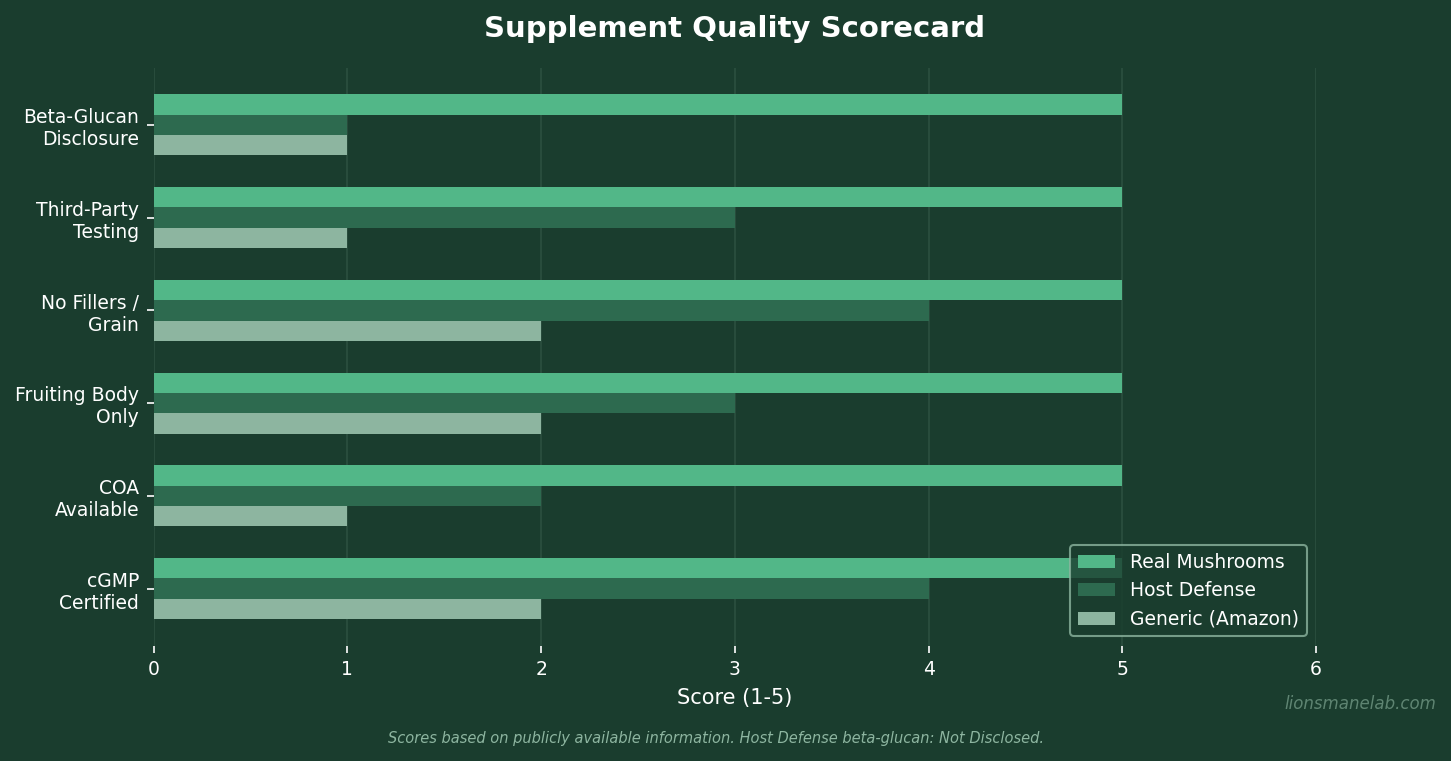
No review is complete without context. Here is how Real Mushrooms stacks up against some of the other prominent lion’s mane brands on the key quality markers we evaluate in our best lion’s mane supplement ranking.
Against Host Defense (Stamets)
Host Defense, founded by mycologist Paul Stamets, is arguably the most recognized mushroom supplement brand. Their lion’s mane product uses a blend of fruiting body and mycelium. However, Host Defense does not publicly disclose beta-glucan percentages on their labels, which is a noted limitation for quality-focused buyers who want to verify potency. Real Mushrooms has a clear advantage in transparency and measurable beta-glucan disclosure.
Against Om Mushrooms
Om Mushrooms also uses fruiting body and holds USDA Organic certification, which gives them strong brand trust. Their products are well-regarded, but Real Mushrooms edges ahead on the specific combination of per-batch COA availability and publicly stated beta-glucan thresholds.
Against Mycelium-Based Products
Any lion’s mane supplement that lists “mycelium biomass” as its primary ingredient without specifying that it is a proper extract warrants caution. These products may contain significant grain starch from the growing substrate, which dilutes active compound concentration. Real Mushrooms avoids this issue entirely by using exclusively fruiting body material.
Honest Downsides and Limitations
We aim to provide balanced assessments, and Real Mushrooms is not without its drawbacks. Here are the areas where this brand may not meet every buyer’s expectations.
Price Point
Real Mushrooms is priced at the higher end of the lion’s mane market. A 120-capsule bottle typically runs between $27 and $35 depending on the retailer. For consumers on a tight supplement budget, this may feel steep compared to brands selling for $15 to $20. However, when you account for verified beta-glucan content and 100% fruiting body formulation, the cost per milligram of actual active compounds is competitive.
Availability
While Real Mushrooms sells directly through their own website and through Amazon, they are not as widely available in brick-and-mortar retail stores as some competitors like Host Defense. If you prefer to buy supplements in person at a health food store, you may not find Real Mushrooms on the shelf.
Limited Formats
Real Mushrooms focuses on capsules and powder. They do not offer a dual-extract tincture, which some users prefer for faster absorption or for combining both hericenones and erinacines. If a tincture format is important to you, you may need to look elsewhere for that specific delivery method.
Not a Quick Fix
This is not a limitation of the brand specifically but of lion’s mane as a supplement. Research suggests that benefits tend to build over weeks of consistent use. Anyone expecting dramatic overnight results from any lion’s mane product, including this one, is likely to be disappointed. Individual results vary, and patience with consistent daily use is necessary. For a realistic picture of what to expect, review our notes on lion’s mane side effects and safety.
Frequently Asked Questions
Is Real Mushrooms lion’s mane worth the higher price compared to budget brands?
For most people who prioritize supplement quality, yes. The verified beta-glucan content above 25%, 100% fruiting body formulation, per-batch COAs, and cGMP manufacturing address the most common quality concerns in this market. Budget brands that use mycelium biomass on grain may cost less per bottle, but without disclosed beta-glucan levels you cannot verify how much bioactive extract you are actually getting.
How long does it take to notice effects from Real Mushrooms lion’s mane?
Based on the available research and user reports, most people begin to notice subtle effects within two to four weeks of consistent daily use. Some individuals report earlier responses, while others may need six to eight weeks. Lion’s mane appears to work through mechanisms that build over time, including supporting NGF production, which is not an overnight process. Consistency with your daily dose is more important than the specific amount you take on any given day.
Can I take Real Mushrooms lion’s mane with other supplements?
Lion’s mane is generally recognized as safe and is commonly stacked with other nootropic and adaptogenic supplements. Popular combinations include pairing it with Alpha-GPC for choline support or Rhodiola Rosea for stress-related cognitive fatigue. If you are taking blood thinners, immunosuppressants, or any prescription medication, consult your healthcare provider before adding lion’s mane to your routine. Individual results vary.
Does Real Mushrooms use organic lion’s mane?
Yes. Real Mushrooms sources their lion’s mane from organic farms. The mushrooms are grown, harvested, and extracted using methods that prioritize purity and active compound concentration. Their organic sourcing, combined with the third-party testing program, provides a strong chain of quality assurance from farm to finished product.
Where is the best place to buy Real Mushrooms lion’s mane?
You can purchase directly from the Real Mushrooms website, which often offers the best pricing and subscription discounts. They are also available on Amazon, though pricing may vary. Buying direct typically ensures you receive the freshest stock and can request batch-specific COA documents.
The Bottom Line
Real Mushrooms has built their brand on a straightforward value proposition: use 100% fruiting body, verify beta-glucan content through independent labs, make those results available to customers, and manufacture under cGMP standards. In a market full of vague labels and undisclosed ingredient quality, that combination of transparency and quality control stands out.
The product is not the cheapest option available, and it does not come in every format. But for consumers who prioritize knowing exactly what is in their supplement and want third-party verification to back it up, Real Mushrooms is one of the strongest choices in the lion’s mane category.
If you are ready to try a lion’s mane supplement backed by verified lab results and transparent manufacturing, visit Real Mushrooms here to explore their current offerings and pricing. For a broader comparison of top-ranked products, check our best lion’s mane supplement guide.
References
- Spelman K, et al. “Neurological Activity of Lion’s Mane (Hericium erinaceus).” Journal of Restorative Medicine, 2017.
- Hobbs C. “Medicinal Mushrooms: Ancient Remedies Rediscovered — Quality Analysis of Commercial Products.” HerbalGram, 2003.
- Lion’s Mane — Examine.com Evidence-Based Research Summary
- Memorial Sloan Kettering Cancer Center: Lion’s Mane Mushroom